Inside VoidAccess: An Open-Source, 13-Step Dark-Web OSINT Platform That Fits in Your Terminal
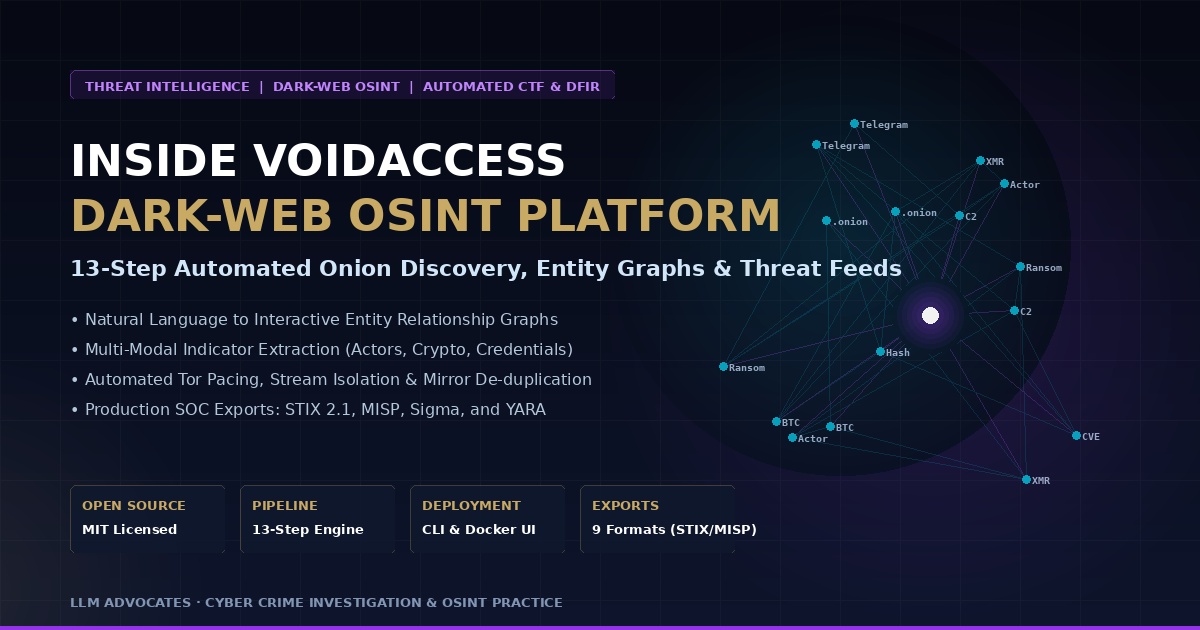
Published 13 November 2026 · LLM Advocates: Cyber Crime Investigation, Dark-Web Forensics & OSINT Practice
Key Takeaways
- Democratizing Dark-Web Threat Intel: VoidAccess is an MIT-licensed, self-hostable OSINT platform turning queries into interactive entity graphs in 13 automated steps.
- Dual Deployment Modes: Available as a lightweight 30-second Python CLI (pip install voidaccess) or a complete multi-user Docker stack (FastAPI, Next.js 14, PostgreSQL 16, Tor proxy).
- Automated Onion Pacing: Queries 12+ Tor search engines, paste sites, and threat feeds while enforcing 1MB page size caps, stream isolation, and Ahmia banned-host filters.
- Multi-Modal Entity Extraction: Extracts and scores threat actors, ransomware infrastructure, crypto wallets (BTC, XMR, ETH), masked credentials, and messaging handles (Telegram, Session, Tox).
- Production SOC Exports: Generates machine-readable intelligence across 9 formats, including STIX 2.1 bundles, MISP events, Sigma detection rules, and YARA signatures.
- Strict Legal Boundaries: Targets only publicly indexed Tor services without bypassing authentication or transacting on illicit marketplaces.
For most enterprise security operations centers (SOCs) and incident response teams, dark-web threat intelligence comes with a steep financial barrier. Commercial threat intelligence platforms routinely demand five-figure annual subscriptions: putting automated hidden-service collection, ransomware actor correlation, and structured indicators of compromise (IOCs) out of reach for independent researchers, smaller security teams, and law firms.
Enter VoidAccess, an MIT-licensed, self-hostable dark-web OSINT platform created by principal security architect Katriel Moses (known for companion security tools MailAccess and APIaxess). Engineered to guide an investigator "from query to graph in 13 steps," VoidAccess has rapidly gained widespread adoption in the open-source threat intelligence community (surpassing 1,100 GitHub stars and 140 forks) and recently released v2.2.1 alongside a hosted web platform at voidaccess.pro.
In this technical breakdown, the cyber forensic specialists at LLM Advocates explore how VoidAccess works under the hood, analyze its multi-layer extraction architecture, review its application security hardening, and explain how security professionals can deploy it safely.
The Operational Bottleneck VoidAccess Resolves
Investigating a ransomware cartel, an extortion leak portal, or a compromised credential repository manually over the Tor network is notoriously tedious, volatile, and operationally hazardous:
- Unstable Search Infrastructure: Dark-web search engines frequently go offline, time out mid-query, or return dead mirror links.
- Raw Text Dumps Lack Context: Copying
.onionaddresses, cryptocurrency transaction hashes, and threat actor handles into spreadsheets conceals the most critical forensic intelligence: the geometric graph of how those disparate entities connect. - Operational Security (OpSec) Exposure: Executing ad-hoc dark-web reconnaissance directly from an enterprise workstation or corporate egress IP exposes infrastructure to counter-surveillance or network monitoring.
- Detection Engineering Deficit: SOC analysts do not just need narrative summaries; they require actionable detection artifacts, including STIX 2.1 bundles, MISP events, Sigma rules, and YARA signatures.
VoidAccess automates this complete investigative lifecycle, converting a single natural-language query into a sourced technical report, an interactive entity relationship graph, and standardized machine-readable intelligence feeds.
Hosted vs. Self-Hosted: Two Investigation Architectures
Depending on organizational risk tolerance and OpSec requirements, VoidAccess supports two distinct deployment models:
1. Hosted Platform (voidaccess.pro)
For investigators who require instant execution, or organizations that strictly prohibit Tor traffic from originating within corporate IP space, the hosted service routes the analytical engine through managed cloud proxies:
- Live Pipeline Telemetry: An execution monitor visualizes every discovered link in real time, noting whether it was retained, filtered, dropped due to HTTP 404, or discarded by safety filters.
- Interactive Graph Explorer: Findings populate an interactive WebGL entity graph classified by threat category.
- Free Monthly Allocation: Offers 100 complimentary monthly credits (equivalent to approximately 5 Quick or 2 Standard investigations) with no credit card required.
2. Self-Hosted Deployment (CLI or Enterprise Container Stack)
Because the core engine is released under the permissive MIT license, organizations can host the entire platform on isolated internal infrastructure:
Option A: 30-Second Python CLI Setup (Python 3.10+)
pip install voidaccess
voidaccess configure                      # Set LLM provider, enrichment API keys, Tor
voidaccess investigate "LockBit ransomware"
voidaccess export <id> --format stix
For immediate triage without setting up a local Tor daemon or configuring external LLM API tokens, the CLI supports an instant clearnet-only mode:
voidaccess investigate "LockBit ransomware" --no-llm --no-tor --depth shallowOption B: Full Docker Compose Infrastructure: For incident response teams requiring multi-user role-based access control, relational case management, and web-based graph visualization, running bash setup.sh deploys four coordinated microservices:
- PostgreSQL 16: Structured relational persistence for actor dossiers, graph relationships, and audit trails.
- Tor SOCKS5 Proxy: Isolated network daemon handling encrypted onion routing.
- FastAPI Backend: High-concurrency Python orchestrator driving the 13-stage collection pipeline.
- Next.js 14 Frontend: Responsive TypeScript and Tailwind user interface featuring real-time WebSocket telemetry.
Under the Hood: Deconstructing the 13-Step Pipeline
Examining the core repository layout (analysis, crawler, extractor, feeds, fingerprint, graph, pacing, sanitizer, scraper, search, sources, trust_gate, vector), VoidAccess is engineered as a resilient distributed pipeline rather than a brittle web scraper. Every step enforces per-phase timeouts and graceful fallbacks, recognizing that on the dark web, intermittent engine failure is standard operating behavior.
- Query Refinement and Multilingual Expansion: An LLM normalizes the search syntax while preserving technical identifiers (hashes, handles, or CVE identifiers). It translates and fans out search queries across English, Russian, and Chinese surfaces to capture non-English cybercrime operations.
- Concurrent Multi-Surface Collection: Simultaneously queries 12+ Tor search engines, curated onion directory seeds, open-source code repositories (GitHub, GitLab), paste sites, and threat intelligence feeds (AlienVault OTX, abuse.ch MalwareBazaar, ThreatFox, URLhaus, CISA KEV, Shodan InternetDB, GreyNoise, and AbuseIPDB).
- Paced Onion Crawling & Defanged Sweeps: Discovered hidden services are crawled through Tor stream isolation using adaptive pacing profiles. Pages are restricted to a 1MB transfer cap and deduplicated against a persistent snapshot store. Version 2.2.1 introduces automatic detection of defanged v3 onion strings and mirror consolidation.
- Multi-Modal Entity Extraction: Combines deterministic regular expressions, spaCy Named Entity Recognition (NER), and generative LLM parsing to harvest indicators across six distinct categories:
| Indicator Category | Extracted Artifacts & Attributes |
|---|---|
| Threat Actors | Actor aliases, ransomware syndicates, malware strains, MITRE ATT&CK technique IDs. |
| Infrastructure | IPv4/IPv6 addresses, fully qualified domains, .onion endpoints, cryptographic file hashes (MD5, SHA-1, SHA-256). |
| Crypto Wallets | Bitcoin (BTC), Monero (XMR), Ethereum (ETH), Litecoin (LTC), Zcash (ZEC), Solana (SOL), and Tron (TRX). |
| Credentials | Cloud API tokens, private JWTs, service credentials, masked stealer-log dumps, and combo-list samples. |
| Messaging Channels | Telegram handles and channels, Discord server links, XMPP/Jabber JIDs, Tox IDs, Session IDs, and Matrix rooms. |
| Vulnerabilities | Common Vulnerabilities and Exposures (CVE) IDs, Exploit-DB references, zero-day claims. |
- Cross-Alias Resolution & Persistent Graph Analysis: Rather than dumping isolated text, VoidAccess correlates actors across historical investigations by identifying overlapping infrastructure, shared PGP key fingerprints, string similarities, and temporal proximity.
- Vector Memory & Semantic Clustering: Employs embedding vectors (via sentence-transformers or a zero-dependency deterministic encoder) to identify semantically related clusters across historical investigations.
Pluggable AI Backend: Zero Vendor Lock-In
During the configuration routine (voidaccess configure), practitioners can select from diverse model providers based on budgetary and data privacy constraints:
- OpenRouter: Supports DeepSeek, Llama 3.3, and Claude Haiku (recommended default with free model options).
- Groq: Ultra-fast Llama 3.3 and 3.1 inference featuring generous free tiers.
- Google Gemini: Gemini 1.5 Flash and 2.5 Pro integrated via Google AI Studio.
- Ollama (100% Local and Air-Gapped): Enables complete offline inference for sensitive sovereign intelligence operations, classified law enforcement investigations, and closed research labs.
Safety Architecture and Enterprise Multi-User Hardening
Collecting data from the dark web introduces profound legal, ethical, and application security liabilities. VoidAccess integrates rigorous controls:
- Publicly Reachable Surface Only: VoidAccess strictly queries public indexes and paste sites. It does not breach access controls, bypass paywalls, infiltrate private forums, or purchase contraband data.
- Mandatory Content Sanitization: Prohibited keywords and malicious URLs are dropped by the
trust_gateandsanitizermodules before reaching user view. Version 2.2.1 includes automated cross-referencing against the Ahmia banned-host MD5 registry and renders all onion addresses as unclickable plaintext to avoid accidental navigation. - Enterprise Security Controls (v2.1.0+): Incorporates revocable HttpOnly session management, strict tenant data isolation, global rate limiting (120 requests/minute defaults), and server-side request forgery (SSRF) protections within the scraping layer.
Operationalizing Intelligence: 9 Standard SOC Export Formats
Once an investigation concludes, VoidAccess exports findings into industry-standard threat sharing and detection formats with a single command:
voidaccess export <investigation_id> --format stix     # STIX 2.1 JSON bundle
voidaccess export <investigation_id> --format misp     # MISP event package
voidaccess export <investigation_id> --format sigma    # Detection engineering rules
voidaccess export <investigation_id> --format yara     # File & memory signatures
voidaccess export <investigation_id> --format md       # Formatted case report
Legal Implications Under Indian Cyber Law & Evidence Rules
For Indian corporate security teams, forensic investigators, and law enforcement agencies deploying automated dark-web intelligence platforms, critical statutory guardrails apply:
- Evidence Admissibility under Section 63 BSA 2023: When dark-web intelligence is tendered in judicial proceedings (such as establishing corporate extortion or tracing stolen intellectual property), Section 63 of the Bharatiya Sakshya Adhiniyam, 2023 requires verified provenance and hash preservation. VoidAccess's automated snapshot stores and deterministic extraction logs satisfy the chain of custody required for electronic records.
- Section 66F, Information Technology Act, 2000 (Cyber Terrorism): Monitoring threat actor communications regarding critical national information infrastructure (CII) or sovereign extortion requires strict compliance with statutory surveillance authorisations under Section 69 of the IT Act.
- PMLA & Crypto Tracing: Cryptocurrency wallets identified on ransomware extortion blogs provide actionable intelligence for tracking money laundering flows under the Prevention of Money Laundering Act (PMLA), 2002.
Conclusion: An Essential Open-Source Asset for Modern SOCs
VoidAccess does not claim to replace comprehensive human-intelligence reporting inside multi-million-dollar defense programs. However, for SOC analysts triaging ransomware alerts, threat researchers mapping dark-web infrastructure, or investigators building automated threat pipelines without enterprise software budgets, VoidAccess is one of the most capable open-source tools released this year.
About LLM Advocates: LLM Advocates is a specialized cyber law and forensics practice advising on Cyber Crime Investigation, digital forensics, evidence admissibility under BSA 2023, and Data Protection Compliance. Explore our OSINT Resources or contact our cyber legal team.
Project Links: GitHub Repository: github.com/KatrielMoses/voidaccess | Hosted Platform: voidaccess.pro | PyPI Package: pip install voidaccess | Author: Katriel Moses.