Inside SilentAir: How an Espionage Group Hijacked Asian Telecom Networks to Intercept Texts and 2FA Codes
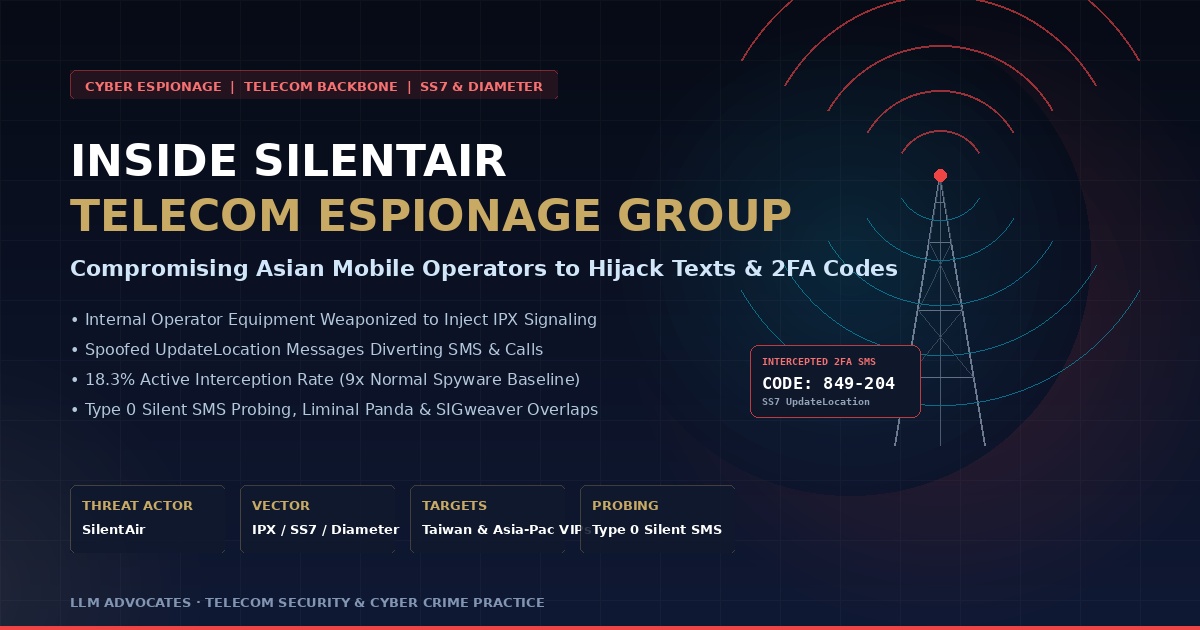
Published 13 November 2026 · LLM Advocates: Telecom Security, Critical Infrastructure & Cyber Espionage Practice
Key Takeaways
- Internal Equipment Compromised: SilentAir breached core equipment inside licensed mobile network operators across at least six Asian countries, injecting malicious signaling directly into the IPX backbone.
- Active Traffic Diversion: Exploited SS7 UpdateLocation and Diameter routing commands to trick home carriers into redirecting SMS and calls to attacker-controlled nodes.
- Targeted 2FA Theft: Active interception made up 18.3% of observed attacks (nearly 9x the normal 2.1% baseline of commercial surveillance software), harvesting two-factor authentication codes primarily targeting high-value Taiwanese subscribers.
- Silent SMS Probing: Deployed Type 0 SMS messages with promotional spam disguises to test traffic diversion during daytime and verify active intercept status overnight.
- State-Sponsored Attribution: Activity patterns strictly aligned with China Standard Time (UTC+8) and heavily targeted Taiwan, with operational overlaps to Liminal Panda (GTPDoor) and SIGweaver/SCTPE kernel malware.
- Defense Mandate: Telecoms must abandon blind trust in peer IPX traffic, deploy unified GTP and signaling firewalls, and integrate signaling telemetry directly into enterprise SOCs.
The global telecommunications backbone relies on an interconnected architecture of inter-operator trust. When you travel abroad or receive an SMS from across the globe, mobile network operators use legacy and modern signaling protocols to seamlessly route your communications. However, when advanced threat actors compromise physical equipment inside those trusted operator networks, that foundational infrastructure is inverted into an invisible wiretap.
This week, Stockholm-based telecom security and software intelligence firm Enea disclosed the discovery of SilentAir, a sophisticated, state-level cyber espionage collective. By compromising core carrier infrastructure across at least six Asian nations, SilentAir has systematically diverted phone calls and text messages (intercepting high-value two-factor authentication [2FA] passcodes), primarily targeting political, government, and corporate VIPs in Taiwan.
In this technical briefing, the telecom security and cyber law analysts at LLM Advocates dissect SilentAir's tactical playbook, explain why its active interception tradecraft sets a dangerous precedent, and review the regulatory imperatives for telecom operators under modern critical infrastructure mandates.
Weaponizing the IPX: How SilentAir Diverts Telecom Traffic
To enable international roaming and inter-carrier messaging, mobile operators exchange signaling traffic across a private global interconnect known as the IPX (IP Packet Exchange), utilizing SS7 (Signaling System 7) in 2G/3G networks and Diameter in 4G LTE environments. Historically, traffic arriving via the IPX has been treated with an implicit assumption of legitimacy.
Commercial surveillance vendors typically lease access to the IPX through grey-market telecom intermediaries or spoof global title addresses from the exterior. SilentAir executed a far more insidious maneuver: they compromised actual core hardware inside legitimate Asian carriers. By staging signaling attacks directly from trusted partner nodes, their malicious commands bypassed perimeter firewall filters that reject unauthorized external origination.
The Interception Playbook: Step by Step
- Spoofing Location Updates: SilentAir transmits forged
UpdateLocationmessages (or DiameterUpdate-Location-Request[ULR] commands) to a target's authentic home network (the HLR/HSS). These messages falsely assert that the subscriber has roamed into territory served by the compromised operator's Mobile Switching Center (MSC) or Serving GPRS Support Node (SGSN). - Diverting Inbound Traffic: When the target's home network accepts the fraudulent location update, the routing table updates globally. Any incoming telephone calls and SMS text messages intended for the victim are immediately routed to the attacker's compromised carrier equipment rather than the legitimate handset.
- Harvesting Authentication Passcodes: Enea confirmed that numerous location diversions succeeded. Immediately following successful routing overrides, analysts documented the interception of one-time two-factor authentication (2FA) SMS passcodes: a clear indication of real-time account takeover attempts against high-value targets.
Interception vs Tracking: A 9x Surge Over Industry Baselines
The vast majority of signaling intrusions tracked on international carrier links originate from commercial spyware vendors, which overwhelmingly concentrate on passive geolocation tracking. In Enea's broader historical baseline, active content interception represented a modest 2.1% of all signaling events.
For SilentAir, however, active content interception accounted for an astonishing 18.3% of observed activity: nearly nine times the customary industry baseline. This statistical skew highlights an operational objective centered on credential harvesting and account hijacking rather than passive location surveillance.
| Attack Metric | Commercial Spyware Baseline | SilentAir Espionage Campaign |
|---|---|---|
| Primary Objective | Passive Geolocation & Cell-ID Tracking | Active SMS Diversion & 2FA Interception |
| Interception Proportion | 2.1% of all signaling queries | 18.3% of all signaling queries (8.7x increase) |
| Originating Node | Leased access brokers, external spoofing | Compromised internal hardware inside licensed telcos |
| Target Geographic Focus | Global, opportunistic dissidents & journalists | Taiwanese government & political VIPs, regional Asian telcos |
The Dual Role of "Silent SMS" Probing
A sophisticated hallmark of SilentAir's operational tradecraft was its extensive reliance on Silent SMS (Type 0 SMS): specialized protocol packets that ping a target handset at the baseband radio level without displaying any visual alert or ringtone to the user.
The attackers deployed Type 0 messages with surgical operational choreography:
- Daytime Litmus Testing: During business hours, SilentAir dispatched silent texts across Southeast Asian and regional partner networks. If the delivery report looped back to the compromised carrier node rather than the subscriber's legitimate radio tower, the operators verified that their traffic diversion was actively capturing messages.
- Nighttime Bulk Verifications: Massive bursts of silent SMS traffic occurred between 1:00 AM and 5:00 AM, concentrated heavily against Taiwanese numbers. Because mobile phones remain stationary while subscribers sleep, handsets rarely perform authentic location updates overnight. SilentAir leveraged this window to confirm that previously hijacked routing states remained undisturbed.
- Spam Payload Failsafes: In a clever operational contingency, the attackers populated the payload bodies of these silent messages with promotional, marketing, or motivational English text. If an intermediate transit provider stripped the Type 0 silent flag during protocol conversion, the recipient merely observed a mundane spam SMS and dismissed it without suspicion.
Attribution Analysis: The China Nexus, Liminal Panda & SIGweaver
Enea assessed with high confidence that SilentAir operates as a state-sponsored offensive entity, pointing to several structural indicators linking the campaign to China:
- Geopolitical Targeting Profile: SilentAir focused overwhelmingly on Taiwanese political, government, and telecommunications targets, while scrupulously avoiding any reconnaissance against Chinese domestic mobile networks or subscribers.
- UTC+8 Working Schedule: Attack velocity strictly conformed to China Standard Time (UTC+8): initiating operations at 9:00 AM, tapering off substantially over weekends, and pausing entirely during recognized Chinese national holidays.
- Co-location with Liminal Panda (GTPDoor): In multiple breached operators, SilentAir command traffic coincided with active infections of Liminal Panda, a well-documented telecom threat actor. Enea observed Liminal Panda's
GTPDoorbackdoor across 5 to 10 carrier networks during early 2026, including modernized variants tunneling commands inside user-plane (GTP-U) encapsulated data. - Kernel-Level Tooling (SIGweaver / SCTPE): SilentAir's network behavior partially mirrors
SIGweaver(also designated SCTPE by CrowdStrike and Singapore's IMDA), a stealthy Linux kernel rootkit engineered to inject and capture raw SS7 and Diameter signaling. However, SilentAir exhibited significantly tighter operational security and was uniquely capable of answering unsolicited signaling messages that it had not generated itself.
Five Strategic Imperatives for Telecommunications Defense
SilentAir decisively proves that perimeter defenses are obsolete when an adversary operates from trusted internal nodes within the IPX federation. Enea outlined five mandatory defensive priorities for network operators:
- Unify Multi-Protocol Firewall Intelligence: Modernize carrier firewalls to inspect both GTP-C (control plane) and GTP-U (user plane), while programmatically sharing threat intelligence with SS7 and Diameter packet inspectors.
- Exceed Baseline Regulatory Compliance: Standard GSMA baseline recommendations (such as FS.11 and FS.19) are well-understood by state actors. Carriers must implement dynamic behavioral anomaly detection beyond rigid rule sets.
- Implement Strict Zero Trust on the IPX: Treat all incoming signaling packets as inherently untrusted, regardless of whether they claim to originate from an established peer operator.
- Internal East-West Signaling Monitoring: Deploy deep packet inspection inside the core network to catch rogue internal hardware executing unauthorized
UpdateLocationcommands. - Bridge Telecom Signaling with the Enterprise SOC: Connect telecom signaling telemetry directly to the Security Operations Center (SOC) so that signaling anomalies can be correlated with host-level alerts and credential compromises.
Regulatory & Legal Context Under Indian Telecommunications Law
For Indian telecom service providers (TSPs) and enterprise CISOs, the SilentAir disclosure directly intersects core statutory requirements:
- National Security Directive on Telecommunication Sector (NSDTS): Mandates that all active equipment deployed in Indian telecom networks must be procured exclusively from "Trusted Sources" with verified supply chain provenance. SilentAir demonstrates that ongoing hardware integrity monitoring is just as critical as initial procurement vetting.
- Critical Information Infrastructure (CII) Protection: Under Section 70 of the Information Technology Act, 2000, telecommunications backbones are notified Critical Information Infrastructure. The National Critical Information Infrastructure Protection Centre (NCIIPC) requires 24/7 telemetry monitoring to prevent unauthorized systemic interception.
- Section 66F, IT Act, 2000 (Cyber Terrorism): State-sponsored diversion of telecommunications traffic aimed at subverting communications sovereignty constitutes an offense of cyber terrorism, punishable with life imprisonment.
- The End of SMS-Based 2FA: For banking, critical infrastructure, and government portals, SMS-based two-factor authentication is fundamentally insecure against state-level adversaries. Organizations must transition urgently to cryptographic hardware security keys (FIDO2/WebAuthn) or time-based one-time password (TOTP) authenticator applications that operate independently of cellular signaling channels.
Conclusion: The Architecture of Trust Must Be Rebuilt
The SilentAir campaign represents a watershed moment in telecommunications security. By breaching core carrier equipment across multiple jurisdictions, the attackers turned the global roaming infrastructure into an active surveillance instrument: capturing SMS passcodes and compromising target accounts with surgical precision.
As telecom networks transition toward 5G standalone (5G SA) architectures, adopting Zero Trust signaling validation, eliminating legacy protocol fallbacks, and abandoning SMS-based multi-factor authentication are no longer theoretical best practices: they are foundational requirements for national communications sovereignty.
About LLM Advocates: LLM Advocates is a premier cyber law and regulatory practice advising on Telecom Security & Cyber Crime Investigation, Critical Information Infrastructure (CII) compliance, and digital forensics under the IT Act and BSA 2023. For strategic advisory or forensic review, connect with our legal team.
Primary Research Citation: Enea Cybersecurity Advisory on "SilentAir" Telecom Espionage Campaign (November 2026); GSM Association (GSMA) Signaling Security Guidelines.