Inside FaceStealer: How North Korean Hackers Used Fake Video Calls and Stolen Webcams to Steal $400M
Published 13 November 2026 · LLM Advocates: Cyber Crime Investigation, AI Deepfakes & Supply Chain Defense Practice
Key Takeaways
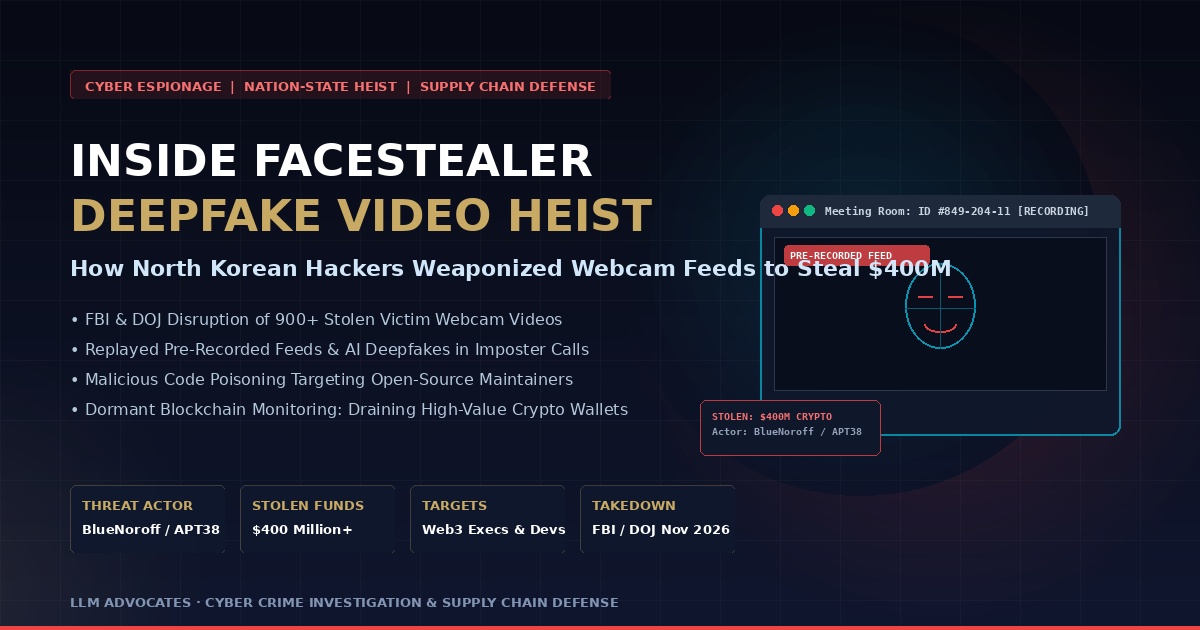
- $400 Million Cryptocurrency Heist: The FBI and U.S. DOJ disrupted the global infrastructure behind FaceStealer, an 18-month campaign attributed to North Korean state-sponsored threat actors.
- Weaponized Professional Trust: Attackers took over authentic executive accounts on Telegram, LinkedIn, Slack, and Discord to lure victims into mock video meetings.
- 900+ Stolen Webcam Feeds & Deepfakes: Investigators seized over 900 secretly recorded victim webcam videos used to replay convincing live-motion footage and synthesize AI deepfakes during calls.
- Supply Chain Poisoning: Beyond targeting Web3 executives, the campaign actively infiltrated the machines of open-source software maintainers to push malicious updates into global code repositories.
- Dormant Wallet Draining: Attackers extracted cryptographic seed phrases and private keys, silently monitoring balances for months before draining funds following large deposits.
- Camera-Off Defense: Security guidelines recommend keeping webcams disabled until caller identities are verified and enforcing hardware MFA on code repositories.
If a trusted colleague or established industry contact sends you a calendar invite on Telegram, Slack, or LinkedIn for a quick 10-minute catch-up, you probably would not think twice before clicking the link. That everyday professional reflex is precisely what North Korean state-sponsored cyber operators exploited to execute one of the most sophisticated social engineering operations in modern cyber history.
In November 2026, the Federal Bureau of Investigation (FBI) and the U.S. Department of Justice (DOJ) unsealed an urgent industry alert detailing the disruption of cloud infrastructure behind FaceStealer: a deceptive cybercrime operation tied to more than $400 million in stolen cryptocurrency over an 18-month span. Even more alarming than the direct financial toll, federal investigators revealed that the attackers systematically targeted open-source software developers and repository maintainers in a calculated attempt to poison the global software supply chain.
Here is an in-depth forensic breakdown of how FaceStealer operated, why its tradecraft proved devastating against tech and Web3 executives, and what engineering teams must do to insulate their infrastructure.
Who Is Behind FaceStealer? The Threat Actor Ecosystem
The FBI attributed the FaceStealer campaign to a prolific cluster of Democratic People's Republic of Korea (DPRK) state-sponsored cyber espionage units. Across the global cybersecurity intelligence community, this cluster is tracked under multiple overlapping designations:
| Threat Group Identifier | Tracking Entity | Primary Specialization |
|---|---|---|
| BlueNoroff | Kaspersky / Industry Standard | Cryptocurrency exchange theft, financial institution subversion, SWIFT heists. |
| Sapphire Sleet | Microsoft Threat Intelligence | Social engineering of cryptocurrency personnel via LinkedIn, Telegram, and fake job lures. |
| APT38 / Stardust Chollima | Mandiant / CrowdStrike | Financial motivation wing of North Korea's RGB (Reconnaissance General Bureau). |
| CryptoCore / UNC1069 | Mandiant / ClearSky | Spearphishing targeting crypto wallets, venture capitalists, and decentralized finance (DeFi) protocols. |
According to U.S. law enforcement, revenue generated from these digital asset operations directly bankrolls the North Korean regime and its prohibited weapons development programs. Alongside the FaceStealer disruption, federal authorities announced the seizure or legal restraint of over $1.2 billion in digital assets tied to a separate $6.3 billion cyber incident attributed to companion threat group TraderTraitor.
While the primary targets were cryptocurrency executives (research from cybersecurity firm Arctic Wolf identified 677 targeted individuals across 58 countries, 84% of whom were founders or C-suite executives), the campaign's operational mandate expanded dramatically into software supply chain subversion. By gaining a persistent foothold on developer laptops, the threat group attempted to compromise source code repositories and push tainted dependencies downstream to millions of commercial and enterprise users.
Anatomy of the FaceStealer Trap: A Five-Step Forensic Review
FaceStealer succeeded not because of complex zero-day exploits, but through meticulous identity hijacking, synthetic media manipulation, and calculated human deception:
Stage 1: Hijacking Trusted Identity Accounts
The attack initiates with a meeting invitation sent from a genuinely compromised account on Telegram, LinkedIn, Slack, or Discord. Using credentials harvested from earlier victims, the hackers read through years of historical chat logs, internal jargon, and contact relationships to draft highly credible, contextual invitations for a routine video check-in.
Stage 2: Luring Victims to Imposter Video Conferencing Portals
The meeting link directs the target to a malicious, attacker-controlled clone mimicking Zoom, Microsoft Teams, or Google Meet. Leading up to the November 2026 disruption, researchers observed the operators expanding their lure infrastructure to impersonate cloud document platforms, media players, and technical audit verification portals.
Stage 3: Replaying Stolen Webcam Feeds and Generative Deepfakes
When the victim enters the bogus room, they see familiar faces rather than an empty screen. During the infrastructure takedown, the FBI seized over 900 secretly recorded webcam videos from the attackers' servers. The operators replayed prerecorded video of prior victims and paired them with generative AI deepfakes modeled after publicly available executive appearances. Simultaneously, the imposter portal secretly recorded the new victim's webcam video, generating fresh bait to target their professional network.
Stage 4: Manufacturing a "Technical Glitch" to Deploy Malware
With interpersonal trust established, the attackers stage a simulated audio or visual defect. Impersonating the familiar contact, they share a troubleshooting link or codec update to resolve the audio issue. Executing that installer quietly drops persistent infostealer and remote access malware onto the victim's operating system.
Stage 5: Long-Term Dormancy and Calculated Wallet Draining
After compromising private keys, seed phrases, or browser credentials, the threat actors do not always strike immediately. Investigators documented multiple cases where operators remained completely dormant for months (or over a year), continuously tracking on-chain wallet addresses until a substantial cryptocurrency deposit arrived before sweeping the funds.
Software Supply Chain Poisoning: Infiltrating the Codebase
While the financial losses are staggering, FaceStealer's deliberate pivot into open-source software development environments presents an existential risk to the technology sector. In at least one verified incident, the FBI confirmed that attackers breached a software developer's workstation and successfully injected malicious code into an actively maintained package before the intrusion was detected and contained.
By compromising a developer's machine, threat actors gain access to:
- Signing Keys & Certificates: Private GPG keys used to sign software releases and commit to Git repositories.
- Package Registry Tokens: Authentication tokens for npm, PyPI, Maven, and Docker Hub, allowing silent deployment of backdoored dependencies.
- Continuous Integration / Continuous Deployment (CI/CD) Secrets: API secrets and cloud deployment keys governing automated build pipelines.
Defensive Playbook: Actionable Protection for Executives & Developers
Although law enforcement neutralized FaceStealer's existing command-and-control servers, the underlying playbook will inevitably be reused by other nation-state and cybercrime syndicates. The FBI's IC3 and industry threat researchers recommend immediate adoption of these safeguards:
1. Enforce "Camera-Off" Verification on Incoming Calls
- Keep your webcam disabled when entering video calls with external or unfamiliar parties until you have positively verified the authentic voice and responsiveness of the host. This prevents attackers from capturing your biometric likeness.
- Scrutinize meeting URLs: confirm that browser-based calls are hosted on official domain names and never accept browser codec downloads or troubleshooting scripts mid-call.
- Out-of-band verification: if a contact sends a file or update link during a call, immediately verify the request through an independent communication channel (such as a direct phone call).
2. Air-Gap Cryptocurrency Assets and Keys
- Restrict hot wallets to minimal working capital; store corporate treasury and personal holdings on air-gapped hardware cold wallets.
- Never store recovery seed phrases or private keys digitally in cloud notes, password managers, text documents, or screenshot archives.
3. Secure Developer Repositories and CI/CD Pipelines
- Mandate phishing-resistant hardware MFA (FIDO2 / WebAuthn security keys) across GitHub, npm, PyPI, and cloud infrastructure accounts.
- Isolate administrative workstations: never conduct untrusted video calls, browse external links, or test unknown software on the same physical system used to sign production code releases.
Legal & Regulatory Implications Under Indian Cyber Law
For organizations operating in India, the tactics documented in the FaceStealer campaign trigger multiple actionable statutory provisions:
- Section 66D, Information Technology Act, 2000 (Cheating by Personation): Generating AI deepfakes, replaying stolen webcam footage, or hijacking social media accounts to induce victims into transferring digital assets constitutes cognizable cyber impersonation, punishable with imprisonment and fines.
- Section 43 and Section 66, IT Act, 2000 (Computer Contaminants & Hacking): Transmitting deceptive codec files to install info-stealers or remote access trojans (RATs) directly violates statutory prohibitions on introducing computer contaminants and unauthorized data extraction.
- Section 66F, IT Act, 2000 (Cyber Terrorism): When state-sponsored actors compromise open-source repositories to poison commercial software supply chains and jeopardize critical infrastructure, the offense escalates to cyber terrorism, carrying a sentence of life imprisonment.
- Prevention of Money Laundering Act (PMLA), 2002: Laundered digital assets originating from cyber extortion and unauthorized wallet drainers fall under the purview of the Enforcement Directorate (ED), necessitating comprehensive on-chain forensic tracing.
Conclusion: Verifying the Face on the Other Side of the Screen
FaceStealer marks a sobering evolution in nation-state social engineering. By converting stolen video into live deception and targeting open-source maintainers, attackers bridged the gap between financial extortion and software supply chain subversion.
Modern enterprise defense is no longer just about vulnerability scanning and perimeter firewalls: it demands a disciplined zero-trust posture toward identity verification, biometric privacy, and software signing hygiene.
About LLM Advocates: LLM Advocates is a premier cyber law practice advising enterprises, founders, and developers on Cyber Crime Investigation, digital forensics, supply chain risk management, and Data Protection Compliance. For emergency incident response or legal review, consult our cyber legal practice.
Primary Sources: FBI Internet Crime Complaint Center (IC3) Public Service Announcement on FaceStealer Campaign (November 2026); U.S. Department of Justice Press Release on Cryptocurrency Infrastructure Seizures; Arctic Wolf Threat Intelligence Advisory.

