Critical Apache HTTP/2 Flaw (CVE-2026-119618) Allows Unauthenticated Remote Code Execution: Patch Now
Published 13 November 2026 · LLM Advocates: Cyber Security, Critical Infrastructure & Technology Law Practice
Key Takeaways
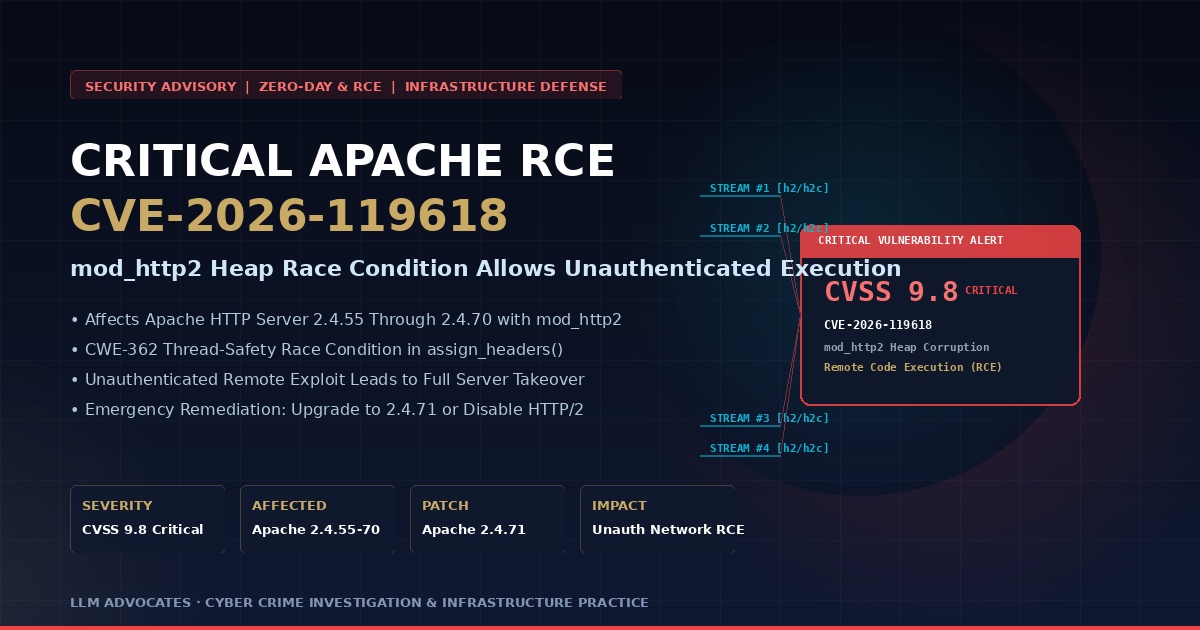
- Critical Severity (CVSS 9.8): CVE-2026-119618 is an unauthenticated, remote code execution (RCE) flaw in Apache HTTP Server's HTTP/2 module (mod_http2).
- Affected Versions: Impacts Apache HTTP Server 2.4.55 through 2.4.70, and standalone mod_h2 releases 2.0.8 through 2.0.42. Addressed upstream in Apache 2.4.71 released November 11, 2026.
- Root Cause: A thread-safety race condition (CWE-362) in assign_headers() causes worker threads to write into connection memory via a shared lock-free allocator, corrupting heap memory.
- Prerequisite: Only servers with HTTP/2 enabled (h2 or h2c via the Protocols directive) are exposed. Servers serving pure HTTP/1.1 or behind HTTP/2-terminating reverse proxies are not vulnerable.
- Immediate Zero-Downtime Mitigation: If patching cannot happen immediately, disable HTTP/2 by setting
Protocols http/1.1and reloading Apache. - Regulatory Alert (CERT-In): Unpatched exploitation triggers mandatory 6-hour incident reporting obligations under Indian IT Act Section 70B directives.
Web administrators, site reliability engineers, and enterprise security teams have an emergency item at the top of their patch queues: a critical vulnerability in the Apache HTTP Server's HTTP/2 module (mod_http2) allows remote, unauthenticated attackers to corrupt server memory and execute arbitrary code with the privileges of the web server daemon.
Tracked as CVE-2026-119618 with a maximum severity CVSS v3.1 score of 9.8 (Critical), the flaw affects Apache HTTP Server versions 2.4.55 through 2.4.70, as well as standalone mod_h2 GitHub releases 2.0.8 through 2.0.42. The Apache Software Foundation resolved the vulnerability in Apache HTTP Server 2.4.71, released on November 11, 2026.
While broad exploitation in the wild has not yet been confirmed, Red Hat warns that security research has already demonstrated reliable proof-of-concept exploitation against default-configured servers with mod_http2 enabled, making immediate patching or mitigation essential across all internet-facing and internal tiers.
Technical Root Cause: Race Condition in assign_headers()
The vulnerability stems from a subtle thread-safety race condition categorized under CWE-362 (Concurrent Execution using Shared Resource with Improper Synchronization) inside the assign_headers() function of mod_http2.
When Apache processes concurrent HTTP/2 streams across multiple worker threads, mod_http2 writes incoming request headers into shared stream data structures. According to Red Hat's security analysis, a worker thread can write into memory owned by the connection thread through a shared, lock-free allocator without proper synchronization barriers.
Mechanism of Compromise:
This unsynchronized concurrent write corrupts the internal heap memory of the Apache child process (httpd). Under precise conditions, a remote attacker can manipulate the corrupted heap layout to overwrite function pointers and redirect control flow: gaining full arbitrary command execution on the host system without requiring credentials, session cookies, or user interaction.
The vulnerability was independently discovered and reported to the Apache security team by Anthropic (via its automated OSS Scanner) and Google Cloud Vulnerability Research.
(Note: Apache HTTP Server 2.4.71 also bundles fixes for two secondary bugs: CVE-2026-106023, an Important-rated NULL pointer dereference in mod_md that can crash worker processes, and CVE-2026-109163, a Low-severity 1-byte stack buffer overwrite in mod_vhost_alias.)
Who Is Affected: Exposure Nuances & Distribution Backports
Before assuming your infrastructure is either vulnerable or immune, evaluate three essential technical criteria:
1. HTTP/2 Must Be Explicitly Enabled
According to Red Hat, only servers with HTTP/2 enabled are vulnerable. Apache's vanilla default configuration serves HTTP/1.1, which never executes the vulnerable mod_http2 memory management paths. A server is only exposed if mod_http2 is loaded and HTTP/2 is enabled via the Protocols directive using either:
h2: HTTP/2 negotiated over TLS (ALPN)h2c: HTTP/2 over cleartext TCP
If your Apache server sits behind a reverse proxy, load balancer, or CDN (such as HAProxy, AWS ALB, Cloudflare, or Fastly) that terminates HTTP/2 at the perimeter edge and forwards strictly HTTP/1.1 to the upstream Apache backend, the vulnerable code path is not directly reachable from the client's public HTTP/2 session. Other web servers, such as nginx and LiteSpeed, are unaffected by this flaw.
2. Virtual Host Configuration Overrides
Apache's Protocols directive can be configured globally in httpd.conf or inside individual <VirtualHost> blocks. Even if your global server configuration specifies Protocols http/1.1, a single virtual host or developer staging subdomain enabling h2 or h2c exposes the shared process worker pool to heap corruption.
3. Linux Distributions and the "Version Banner Trap"
Do not rely solely on Apache's 2.4.55–2.4.70 version string to determine exposure. Many enterprise Linux distributions backport security fixes into legacy version numbers or maintain custom allocator modifications:
| Distribution / OS | Shipped Version | Vulnerability Status & Advisory |
|---|---|---|
| Red Hat (RHEL 9 / 10) | httpd 2.4.57+ | Severity downgraded to Important (allocates separate allocators per stream). Patched via RHSA-2026:98981 (RHEL 9) and RHSA-2026:98978 (RHEL 10). |
| Red Hat (RHEL 8 / 7) | httpd 2.4.37 / legacy | Not Affected (ships older mod_http2 codebase prior to vulnerable rework). |
| Ubuntu 22.04 LTS | apache2 2.4.52 (backported) | Vulnerable due to backported mod_http2. Patched via USN-9090-1. |
| Ubuntu 24.04 LTS / 26.04 | apache2 2.4.58+ | Vulnerable. Upstream fixes released via USN-9090-1. |
| Debian / AlmaLinux / Rocky | Varies by release | Patched builds actively rolling out: audit package repositories directly. |
How to Check Your Server's Exposure in 60 Seconds
Execute the following diagnostic commands across your fleet to verify binary version, loaded modules, and active protocol directives:
1. Check Apache Binary Version:
httpd -v       # RHEL / CentOS / AlmaLinux
apache2 -v     # Debian / Ubuntu
2. Check Whether mod_http2 Is Actively Loaded:
httpd -M | grep http2
apache2ctl -M | grep http2
3. Search All Configuration Files for Protocol Declarations:
grep -rn "Protocols" /etc/httpd/ /etc/apache2/ 2>/dev/nullIf http2_module is loaded and any configuration block contains h2 or h2c (and you have not yet applied version 2.4.71 or vendor backported packages), your server should be treated as exposed to remote compromise.
Remediation and Immediate Zero-Downtime Workarounds
Primary Fix: Immediate Package Upgrade
- RHEL / AlmaLinux / Rocky Linux: Run
dnf update mod_http2 httpdand restart the service viasystemctl restart httpd. - Debian / Ubuntu: Run
apt update && apt install --only-upgrade apache2followed bysystemctl restart apache2. - Docker / Kubernetes Containers: Pull the updated official
httpd:2.4.71base image, rebuild, and redeploy containers. Simply restarting an existing container image does not update underlying binaries. - Standalone mod_h2 Users: Note that the standalone GitHub
mod_h2repository is archived without a standalone release. Migrate immediately to Apache HTTP Server 2.4.71 or disable HTTP/2.
Temporary Mitigation: Disable HTTP/2 in 30 Seconds
If maintenance windows, enterprise change freezes, or vendor distribution delays prevent an immediate binary upgrade, eliminate the attack surface instantly by disabling HTTP/2:
- Edit your global Apache configuration and every virtual host to restrict traffic strictly to HTTP/1.1:
(Alternatively, disable the module directly viaProtocols http/1.1a2dismod http2on Debian/Ubuntu.) - Test configuration syntax and reload Apache without dropping active connections:
apachectl configtest && systemctl reload httpd # RHEL apache2ctl configtest && systemctl reload apache2 # Debian/Ubuntu - Confirm using
curl -I --http2 https://yourdomain.comthat the server negotiates strictly HTTP/1.1.
Impact of Disabling HTTP/2: Negligible. All modern web browsers and REST API clients gracefully fall back to HTTP/1.1 without breaking user sessions. If your web application sits behind a CDN, visitors continue to experience HTTP/2 speeds at the edge while your origin server remains protected.
Threat Hunting & Post-Exploitation Indicators
While patch deployment is underway, Security Operations Centers (SOCs) should actively monitor Apache clusters for indicators of attempted or successful exploitation:
- Segmentation Fault Spikes (SIGSEGV): Because heap race conditions require precise timing, failed exploit attempts frequently trigger memory access violations. Search error logs for recurring child process crashes:
grep -i "segmentation fault" /var/log/httpd/error_log /var/log/apache2/error.log - Anomalous Child Process Execution: Alert on suspicious process ancestry where the web daemon account (
apache,httpd, orwww-data) spawns command interpreters (/bin/sh,/bin/bash), download binaries (curl,wget), or compiler utilities. - Outbound Network Sockets: Monitor egress connections originating from web server worker processes connecting to unknown foreign IP addresses on non-standard ports.
Regulatory & Legal Implications Under Indian Cyber Law
For organizations operating internet-facing infrastructure in India, unaddressed critical vulnerabilities carry severe legal and regulatory liabilities:
- CERT-In Mandatory 6-Hour Reporting Direction: Under Section 70B of the Information Technology Act, 2000 and the CERT-In Cybersecurity Directions of April 2022, any successful compromise, unauthorized system access, or critical service disruption must be formally reported to the Indian Computer Emergency Response Team (CERT-In) within 6 hours of detection.
- Section 43 and Section 66, IT Act, 2000: Failure to apply known security patches to infrastructure hosting consumer or corporate data establishes negligence, exposing corporate leadership to civil compensation claims and regulatory sanctions.
- Digital Personal Data Protection Act, 2023 (DPDP): Under Section 8 of the DPDP Act, Data Fiduciaries are statutorily mandated to implement "reasonable security safeguards" to prevent personal data breaches. Operating unpatched web servers with known pre-authentication RCE flaws directly breaches this duty, exposing entities to statutory penalties of up to Rs 250 crore.
Conclusion: Treat as an Emergency Maintenance Priority
Pre-authentication remote code execution flaws in foundational internet infrastructure rarely remain unexploited for long. Because mod_http2 is widely enabled on production web servers, reverse proxies, and API gateways, enterprise IT leaders must treat CVE-2026-119618 as an emergency maintenance priority.
Audit your Apache configurations today, enforce Protocols http/1.1 as an immediate stopgap if vendor distribution packages are delayed, and roll out Apache 2.4.71 across all environments without delay.
About LLM Advocates: LLM Advocates is a premier cyber law and regulatory compliance practice advising enterprises on Cyber Incident Response, CERT-In compliance, vulnerability disclosure, and DPDP Data Protection Compliance. For emergency legal advisory or forensic breach counsel, consult our cyber practice.
Primary References: Apache Software Foundation Security Advisory for Apache HTTP Server 2.4.71 (Released Nov 11, 2026); Red Hat Security Advisory RHSA-2026:98981; Ubuntu Security Notice USN-9090-1; National Vulnerability Database (CVE-2026-119618).