Stamped (Poststempel): How CORRECTIV's New Open-Source Tool Verifies Leaked Emails Offline
Published 13 November 2026 · LLM Advocates — Digital Forensics, OSINT & Cyber Crime Practice Group
Key Takeaways
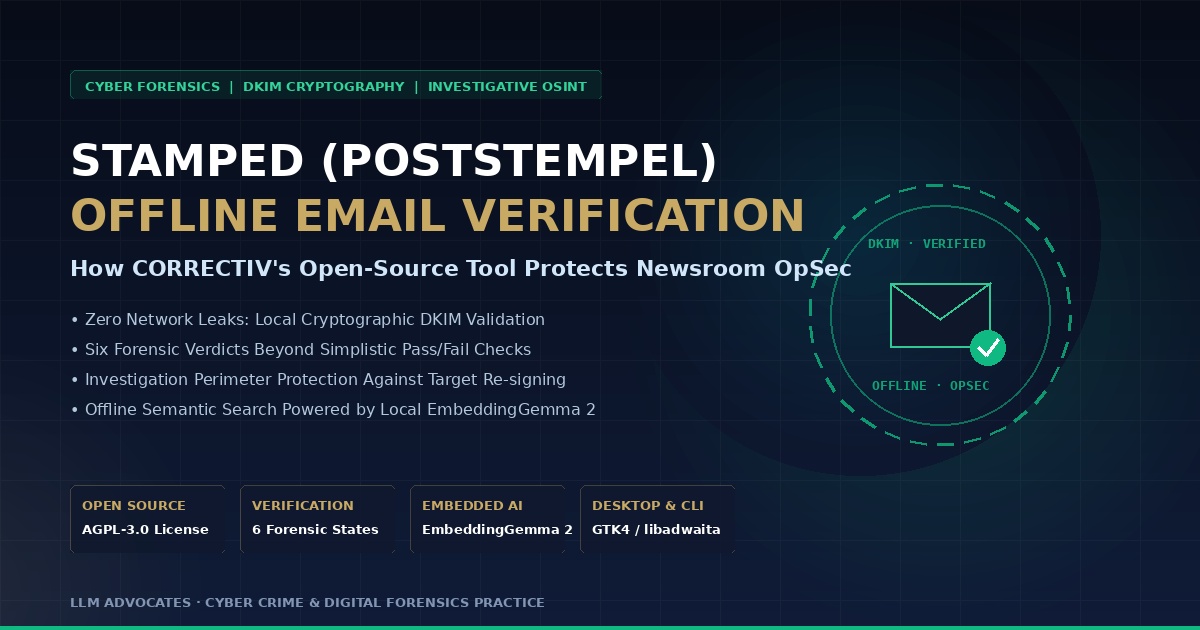
- Zero Network Leakage: Stamped (Poststempel) performs DKIM cryptographic verification locally without making DNS requests that could alert targets under investigation.
- Six Forensic Verdicts: Replaces binary pass/fail checks with six nuanced states: confirmed, confirmed with caveats, body altered, headers altered, unverifiable, and unsigned.
- Investigation Perimeter: Allows investigators to declare target-controlled domains so that re-signed or self-signed forgeries are flagged automatically.
- Safe Archive Ingestion: Handles messy directory trees, streaming large .mbox chunks, blocking symlink escapes, and ignoring non-mail files.
- Offline Semantic Search: Bundles quantized EmbeddingGemma 2 for local vector exploration without sending sensitive leaks to third-party cloud AI APIs.
- Evidentiary Value: Provides verifiable mathematical proof of electronic record integrity, vital for judicial standards under Section 63 BSA 2023.
When a leaked email archive arrives in a newsroom, an investigative agency, or a law firm, the very first question is always the same: is this real? Before a reporter publishes a headline or an advocate tenders an electronic record as evidence, they have to know whether the messages in front of them are authentic or whether an adversary edited a critical line, forged a header, or fabricated an entire exchange from scratch.
To answer that question without exposing sources or alerting targets, the German investigative journalism organization CORRECTIV has released Stamped (known in German as Poststempel). Open-sourced on GitHub at correctiv/stamped under the AGPL-3.0-or-later license, Stamped is built as both a high-throughput command-line utility and a GTK4/libadwaita desktop application. It enables investigators to verify cryptographic signatures, ingest massive mailbox trees, and search leaked archives entirely offline on their own isolated machines.
The Operational Security Problem with Standard DKIM Verification
Most corporate and institutional email sent today carries a cryptographic signature generated via DKIM (DomainKeys Identified Mail, specified in RFC 6376). When an authoritative mail server dispatches an email, it signs the message body and selected header fields using a private key. Anyone possessing the sender's corresponding public key can mathematically verify that the message has not been modified since leaving the originating server.
In theory, DKIM provides investigators with a built-in mechanism to prove whether a leaked email is authentic down to the individual byte. In practice, conventional verification workflows introduce grave operational security (OpSec) risks:
- Web-based verifiers require uploading the leak: Pasting raw
.emlfiles into web-based validation portals exposes confidential source material, attorney-client privileged records, and proprietary whistleblower communications to third-party cloud infrastructure. - Automatic DNS lookups compromise investigations: Standard DKIM libraries resolve public keys dynamically over the network by issuing DNS TXT queries (specifically targeting
<selector>._domainkey.<domain>). If an analyst runs a generic verifier across an unvetted mailbox, those DNS requests travel across public resolvers and can immediately tip off the signing domain's administrators regarding which specific mailboxes, historical date ranges, and selectors are under active forensic scrutiny.
Stamped solves both problems by operating completely local and offline by default. Rather than silently generating network telemetry, it evaluates signatures against a locally maintained key store populated via stamped keys add or supplied directly through --key runtime flags.
When dealing with rotated or archived historical keys, Stamped includes an explicit stamped keys fetch utility that can query public DNS or archive.prove.email (a public repository of historical DKIM keys). Even in this scenario, the tool will never touch the network until it displays the exact domains and selectors scheduled for lookup and receives affirmative user confirmation (unless explicitly bypassed via --yes). No other process in the application ever initiates an external connection.
Six Nuanced Forensic Verdicts Instead of Binary "Pass or Fail"
A defining design achievement of Stamped is its refusal to reduce cryptographic analysis to an oversimplified binary check. As CORRECTIV's documentation emphasizes, collapsing intricate cryptographic states into a blunt "valid" or "invalid" flag is how legitimate investigative stories are spiked or fraudulent accusations are published.
Instead, Stamped scrutinizes each signature independently and returns one of six structured verdicts:
| Verdict | Forensic Meaning | Investigative Impact |
|---|---|---|
| confirmed | Signature verified cleanly against public key. | Proves the message content and signed headers are identical to what left the signing server. |
| confirmed with caveats | Cryptographic math checks out, but scope of protection is limited. | Alerts reporter to weak keys, truncated body signing, or internal leaker key provenance. |
| body altered | Calculated body hash does not match the signature. | Proves someone modified, inserted, or removed body text after the message was signed. |
| headers altered | Body hash matches, but a signed header field does not. | Critical headers (such as From, Date, or Subject) have been tampered with post-dispatch. |
| unverifiable | Signature is present, but local verification resources are missing. | Absence of evidence is not evidence of forgery: often due to key rotation or missing selector keys. |
| unsigned | No DKIM signature exists in the email headers. | Common in internal intra-domain delivery; establishes neither authenticity nor tampering. |
Establishing unverifiable as a distinct forensic classification is paramount. When an email from four years ago displays an unverifiable status, it usually means the originating enterprise rotated its cryptographic keys and decommissioned its legacy DNS record. Treating an unverifiable message as "fake" is a catastrophic forensic error that Stamped actively prevents.
Caveat Handling and the Investigation Perimeter
When Stamped assigns the verdict confirmed with caveats, it itemizes the technical rationale behind the caution:
- Cryptographic Weaknesses: Flags legacy algorithms such as
rsa-sha1(where practical collision attacks exist) or RSA keys under 1024 bits. - Partial Body Length Tags (
l=): The DKIM specification permits anl=tag that restricts signature validation to the initial N bytes of a message body. Any malicious paragraphs appended below that length threshold remain completely unsigned. - Omitted Essential Headers: Flags signatures where foundational headers like
Subject,To, orDatewere left out of the signed header list (h=tag). - Key Provenance Boundaries: If a public key was discovered within the leaked archive itself rather than verified against independent DNS or public archives, Stamped flags this provenance caveat. Internal consistency within a leak does not equate to external objective truth.
The Threat of Target-Controlled Re-Signing:
What happens if the corporation under investigation holds the signing keys? An adversary with administrative control could alter an email in their archive and re-sign it with their own legitimate active key. To defend against this insider threat, reporters can run stamped perimeter --set <domain> to designate target domains. Stamped automatically appends a perimeter caveat to any signature originating from those entities.
Evidence Formatted for Courtrooms and Editorial Boards
Because verification data must be clearly explainable to editors, judges, and opposing counsel, Stamped outputs complete technical metadata: signing domain, selector, hashing algorithm, key bit length, provenance source, and exact expected versus computed SHA-256 body hashes.
Executing stamped verify --cite generates a ready-to-publish citation paragraph detailing what the signature proves, which public key confirmed it, and which caveats attach. In alignment with Unix forensic conventions, exit code 0 signifies that a verification report was produced (regardless of pass or fail verdict), while exit code 2 indicates that processing could not complete.
Ingesting Sprawling and Hostile Mail Archives Safely
Real-world leaks rarely arrive as organized collections of clean .eml files. Instead, they surface as chaotic directories with nested account folders, multi-gigabyte files split across part-01.mbox and part-02.mbox, interspersed with binary assets and text notes.
Stamped's ingest engine (stamped import) is hardened against malicious or corrupt archives:
- Folder Layout as Canonical Truth: Mailbox identifiers are derived directly from folder structure. Stamped explicitly distrusts manifest files packaged by leakers, which could contain spoofed metadata. Duplicate folders are cleanly deduplicated (e.g.,
target@example.comandtarget@example.com (2)). - Strict Format Filtering: Only valid
.mboxand.emlfiles are parsed. Extraneous files are tallied and skipped, preventing non-mail payloads from polluting the database. - Streamed Memory Management: Large
.mboxsegments are streamed sequentially, ensuring that multi-gigabyte leaks do not trigger out-of-memory crashes on consumer laptops. - Directory Traversal & Symlink Shielding: Stamped refuses to follow symbolic links pointing outside the root archive folder, ensuring crafted zip bombs or malicious links cannot read sensitive files from the investigator's host disk.
- Graceful Error Recovery: Corrupted files are logged by path while import execution continues across the rest of the corpus, exiting with code
2to signal that errors occurred without aborting the overall review. Structured progress can be streamed in real time via--progress=jsonl.
Desktop Interface and Local Semantic Search via EmbeddingGemma 2
While power users can script the CLI, Stamped also provides a full desktop application built as a TypeScript monorepo using GJS with a GTK4 / libadwaita interface.
Once an archive is imported, analysts can execute sub-second full-text searches backed by SQLite FTS5, trace message threads, analyze correspondent networks, and export portable .stamped case archives secured with cryptographic integrity manifests.
For thematic exploration without compromising OpSec, the pre-built AppImage and macOS packages bundle a quantized EmbeddingGemma 2 (Q8_0 GGUF, ~296 MiB) model. This enables offline semantic vector search directly on device with zero cloud connectivity. Investigators can query conceptual topics (such as "discussions regarding delayed audit compliance") without leaking search intent to proprietary commercial LLM endpoints.
Legal Implications Under Indian Digital Evidence Jurisprudence
In legal proceedings involving leaked communications, whistleblowing disclosures, or corporate fraud investigations, proving the authenticity of electronic records is governed by stringent statutory rules:
- Section 63, Bharatiya Sakshya Adhiniyam, 2023 (BSA): Replacing Section 65B of the Indian Evidence Act, Section 63 governs the admissibility of electronic records. A Stamped forensic report (documenting unchanged body hashes, RFC 6376 canonicalization, and public key verification) provides objective mathematical substantiation of digital record integrity from origin to presentation.
- Section 66D, Information Technology Act, 2000: For prosecutions involving email spoofing, personation, or CEO fraud, Stamped's
headers alteredandbody alteredverdicts provide definitive proof of post-transmission modification. - Non-Repudiation Defense: When corporate targets claim that leaked emails were fabricated by malicious third parties, a DKIM signature with an external public key establishes cryptographically binding non-repudiation.
Conclusion: Setting a Forensic Standard for Investigative OpSec
For two decades, newsrooms and legal teams faced an uncomfortable compromise: either upload sensitive disclosures to third-party verification tools or run local scripts that inadvertently broadcast investigation targets over DNS resolvers.
With Stamped, CORRECTIV has delivered a tool built around the realities of adversarial reporting: offline verification by default, nuanced multi-state verdicts, robust archive ingestion, and private semantic search. For journalists, cyber investigators, and digital forensic advocates, Stamped sets a new standard for handling leaked digital evidence safely.
About LLM Advocates: LLM Advocates is a premier cyber law practice advising on Cyber Crime Investigation, digital forensics, evidence admissibility under BSA 2023, and Data Privacy Compliance. Access our Investigation Resources or consult our cyber legal practice.
Source Code & Documentation: CORRECTIV Stamped is open source under AGPL-3.0-or-later. Repository: github.com/correctiv/stamped.

