Cabir: The First Mobile Worm & The Dawn of Smartphone Malware
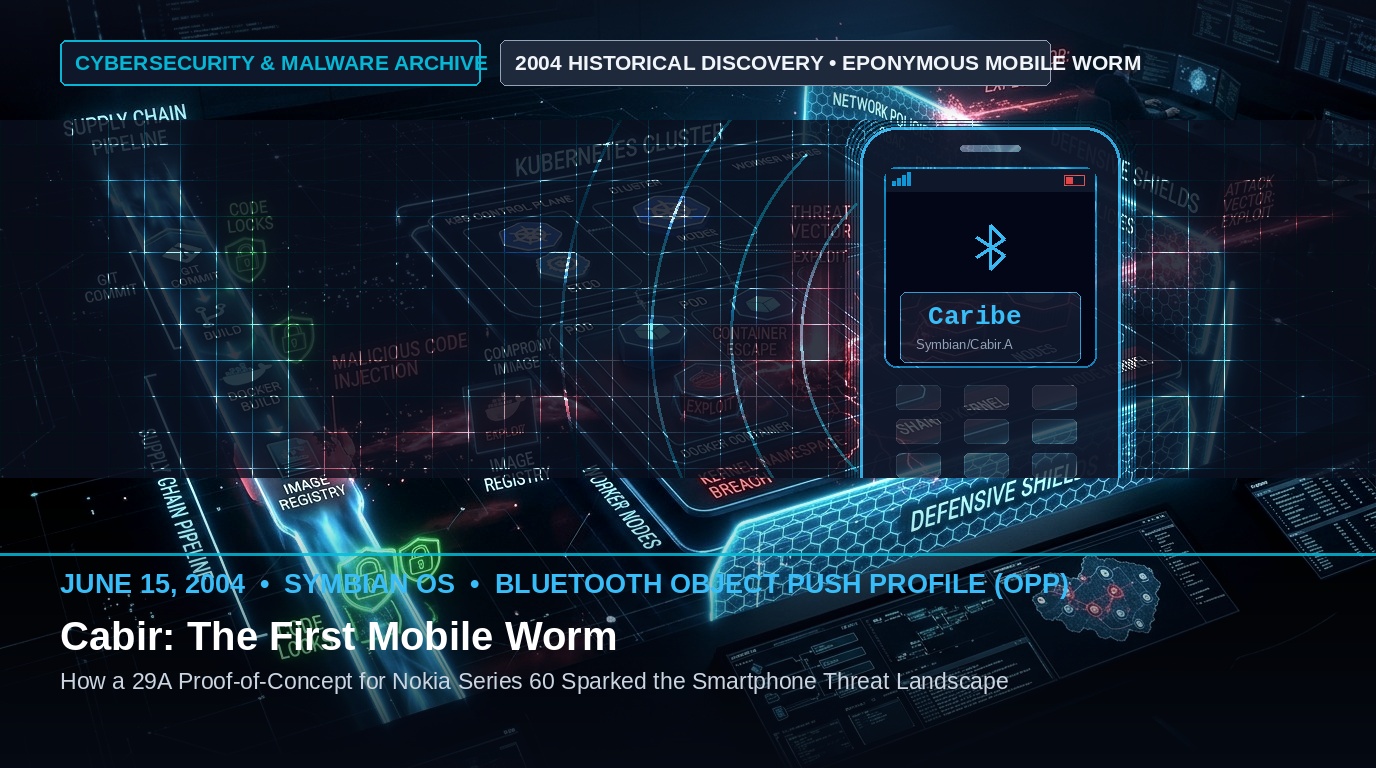
Cabir: The First Mobile Worm & The Proving Ground for Handheld Threats
Research Area: Mobile Security, Symbian Architecture, Bluetooth Protocol Exploits • By: LLM Advocates Blog
Malicious software for mobile devices appeared almost as soon as handheld hardware gained programmability and wireless connectivity. In the early 2000s, however, threats were a rare curiosity. Mobile handsets were far simpler than modern computing devices, and early handheld intrusions were limited to primitive Trojans that masqueraded as utility apps to dispatch covert SMS messages to premium-rate numbers. Everything changed on June 15, 2004, with the documented discovery of Cabir (technically identified as SymbOS/Cabir.A)—the world's first autonomous mobile worm.
1. How Cabir Worked: Anatomy of Bluetooth Self-Propagation
Unlike static Trojans that rely strictly on user trickery for installation, Cabir possessed true worm capabilities: it was self-replicating and self-propagating across short-range radio networks.
When executed on an infected smartphone running the Symbian Series 60 (S60) platform, Cabir carried out a distinct sequence of operational steps:
- Screen Payload: Upon startup, the worm initialized a visual notification displaying the word "Caribe" across the device display (the phonetic origin of its eventual moniker).
- Persistence: The worm copied its primary executable into the Symbian
\System\Apps\directory and established autorun registry hooks to ensure persistence across device reboots. - Radio Scanning: Cabir aggressively activated the handset's internal Bluetooth hardware, scanning for any discoverable device within an approximate 10-meter radius supporting the Object Push Profile (OPP). Notably, OPP was the standardized protocol designed for wireless peer-to-peer sharing of vCards, photos, and media clips—supported not only by Nokia, Sony Ericsson, and Motorola phones, but also by Bluetooth-enabled office printers.
- Transmission & Social Engineering: Once a nearby target was discovered, Cabir dispatched a clone of itself packaged inside a Symbian installation file named
caribe.sis.
The Two-Tier Security Bottleneck in 2004
For a target device to be successfully compromised, user interaction was ordinarily required: the recipient had to manually approve the incoming Bluetooth file prompt and confirm the installation of the .sis package. However, many early handsets were configured by default to accept incoming wireless transmissions automatically. By repeatedly broadcasting pairing and transfer requests, Cabir effectively launched a wireless Denial-of-Service (DoS), flooding the victim's screen with non-stop acceptance dialogs until frustrated users conceded and downloaded the package.
2. A Product of Its Time: The Symbian Era
To understand Cabir's historical impact, one must look at the computing landscape of 2004. Android—which would later grow to dominate both mobile computing and mobile malware—did not exist. iOS would not debut until 2007. The smartphone ecosystem of the mid-2000s belonged overwhelmingly to Symbian OS, backed by the market dominance of Nokia (particularly flagship devices such as the Nokia 6600, 7610, and N-Gage).
Symbian was an advanced preemptive multitasking operating system executing on low-power ARM processors. Because security architectures of the era placed minimal emphasis on code signing or application sandboxing, native binary executables enjoyed direct access to core telephony, hardware subsystems, and communication interfaces.
3. A Quiet Debut: The 29A Connection
Surprisingly, Cabir did not originate "in the wild" as a cybercrime campaign designed for financial extortion or credential theft. Its genesis was an academic and technical demonstration of capability.
In early June 2004, analysts at multiple global antivirus laboratories received an enigmatic email containing an attachment with no subject line and no message body. The return header pointed to "Valtezz", a prominent developer associated with 29A—an elite international virus-writing group notorious for pioneering conceptual malware across novel platforms (including early 64-bit Windows and Linux proof-of-concepts).
The code was explicitly engineered as a Proof of Concept (PoC) to demonstrate that autonomous self-replicating malware could survive and propagate across resource-constrained handheld devices running ARM microprocessors.
4. Inside the Lab: The Naming and Battery Drain Dilemma
Kaspersky Lab analysts first examined the sample in early June 2004. Reverse-engineering revealed that the binary was compiled specifically for Symbian S60. However, conclusively demonstrating that a mobile worm could autonomously discover and infect an adjacent physical device required analysts to source multiple compatible Nokia handsets inside an isolated laboratory environment.
The name itself holds a famous piece of cybersecurity lore. As lab analysts debated whether to name the threat after the internal text string "Caribe", an employee named Elena Kabirova entered the room. Combining the internal string with her surname produced the name Cabir, which became the universal industry identifier.
While Cabir lacked destructive payloads like file deletion or data exfiltration, it introduced a devastating physical side effect: extreme battery exhaustion. Because the worm held the handset's Bluetooth radio transmitter in a continuous high-power transmission loop searching for nearby hosts, it drained fully charged smartphone batteries within two to three hours. While rapid battery drain is common under intensive modern usage, in 2004—when phones routinely lasted three to five days on a single charge—this rapid drain was a startling operational shock.
| Technical Profile: Worm.SymbOS.Cabir.a | |
|---|---|
| Target Platform | Symbian OS v7.0s / Series 60 (S60) 1st and 2nd Edition (ARM architecture) |
| Propagation Vector | Bluetooth RFCOMM / Object Push Profile (OPP) |
| Carrier File | caribe.sis (approx. 15 KB Symbian Installation System package) |
| Installation Path | C:\System\Apps\Caribe\caribe.app and caribe.rsc |
| Direct Payload | Non-destructive; displays modal dialog "Caribe"; continuous radio scanning leading to rapid battery exhaustion |
| First Public Antivirus Fix | TSG Pacific (Australia) released the first specialized removal utility |
5. A Family Tree of Imitators: The Floodgates Open
Although Cabir was conceived as a non-destructive research artifact, the release of its source code by 29A a few months later ignited a cascade of mobile malware development. Threat actors and script kiddies borrowed Cabir's Bluetooth propagation routines to build aggressive, weaponized variants:
- Mosquito (August 2004): A cracked, illicit version of a popular Symbian game that embedded a Trojan sending unauthorized SMS messages behind the user's back.
- Skuller (Late 2004): A destructive Trojan that corrupted system directories, replaced built-in Symbian application icons with images of skulls and crossbones, and leveraged Cabir's wireless engine to propagate across wireless range.
- Pbstealer (2005): A stealthy spyware Trojan that accessed the victim's phonebook/address book, exfiltrated contacts, and broadcast them over Bluetooth to the first responding device.
- Mabir (2005): An advanced hybrid successor that expanded beyond short-range Bluetooth by incorporating Multimedia Messaging Service (MMS) propagation, forwarding itself to phone numbers found in the user's outbox and contact directory.
In total, cybersecurity researchers tracked over 620 distinct Symbian malware variants between 2004 and 2008. The myth of mobile platform invulnerability was definitively shattered.
6. From Symbian to Android: The Changing Threat Landscape
Symbian's reign as the primary battleground of mobile malware was ultimately cut short by the smartphone revolution. With the launch and exponential adoption of Android in the late 2000s, cybercrime syndicates migrated toward Google's open platform:
- By late 2011, Android surpassed Symbian and J2ME as the primary target for mobile malware authors worldwide.
- By 2012, the final commercial Symbian smartphone (Nokia 808 PureView) had rolled off assembly lines.
- By 2014—exactly ten years after Cabir's discovery—malware repositories logged more than 340,000 unique mobile malware samples, with over 99% specifically engineered to target Android.
7. Legacy and Modern Cybersecurity Implications
Looking back from today's threat landscape—dominated by sophisticated spyware like Pegasus, banking Trojans, and zero-click iMessage exploits—Cabir remains a foundational watershed.
Cabir's enduring historical significance was not in the damage it caused, but in the reality it proved: any programmable device that communicates wirelessly is inherently susceptible to autonomous infection. It forced handset manufacturers, telecommunications operators, and software vendors to discard naive assumptions about perimeter security, laying the architectural groundwork for modern application sandboxing, cryptographic code signing, and fine-grained Bluetooth permissions.
References & Historical Sources
- Cabir (computer worm) – Wikipedia
- The very first mobile malware: how Kaspersky Lab discovered Cabir – Kaspersky Lab Archives
- Five stories about Cabir, the first malware for smartphones – Kaspersky Daily
- A brief history of mobile malware – Mobile Commerce Daily / Retail Dive
- Mobile malware – Wikipedia Reference
Editorial Analysis by LLM Advocates Blog
Published by the Cyber Law, Threat Intelligence & Digital Forensics Research Cell at LLM Advocates. Dedicated to analyzing legal, technical, and historical developments in information security and cyber jurisprudence.