Containers Under Fire: From Host Escape to Supply Chain Attacks — A Technical Guide to Container Defense
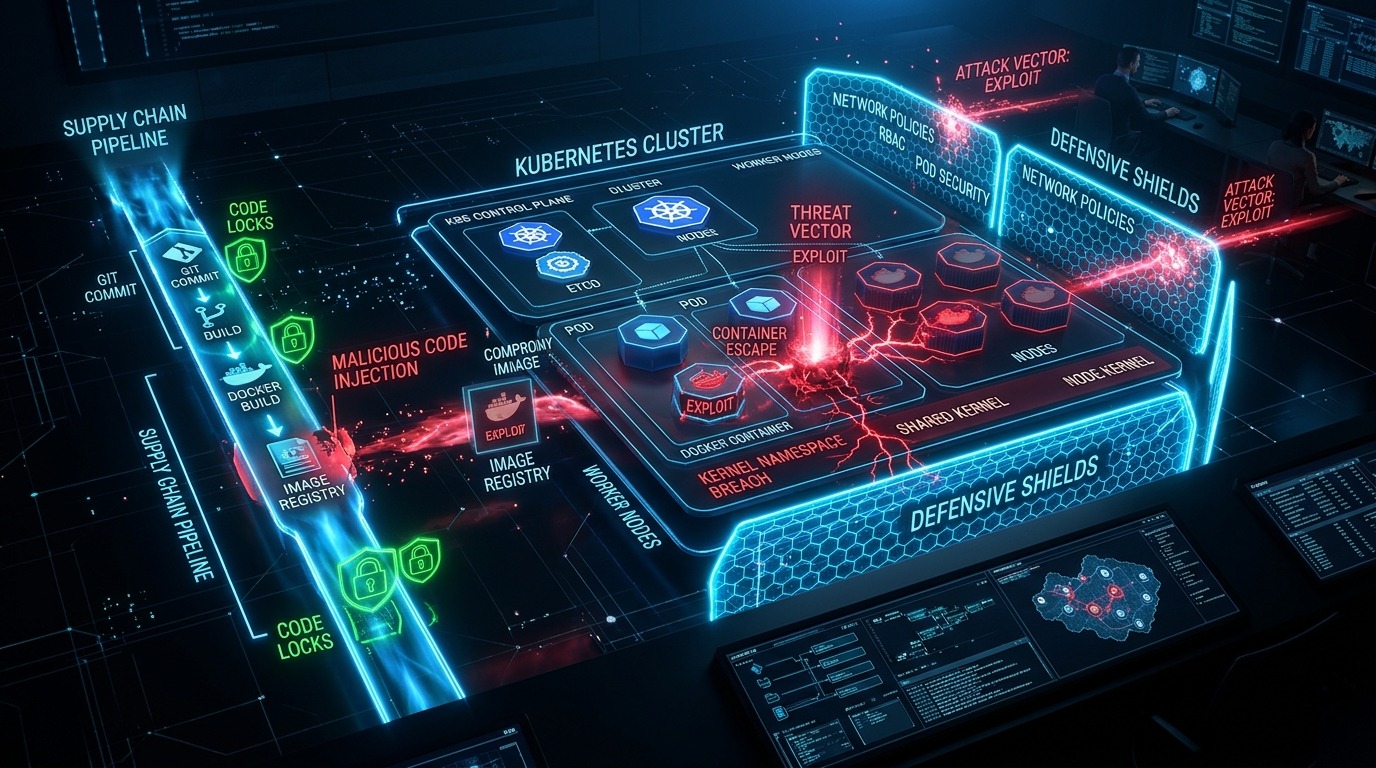
Containers are the undisputed default standard for building and running modern software. Docker, Kubernetes, and their broader cloud-native ecosystem power everything from internal enterprise microservices to hyperscale infrastructure. However, that universal adoption has transformed container platforms into prime adversarial targets. Modern container breaches are rarely single-step exploits; they are sophisticated, multi-stage campaigns that chain together supply chain compromises, credential theft, orchestration API abuse, and kernel-level escapes onto the host node.
A stark real-world case study occurred when the advanced persistent threat (APT) actor TeamPCP compromised Checkmarx KICS across multiple attack chains, including poisoning its public Docker Hub repository. The poisoned images carried a stealthy credential stealer that executed during automated static code scans, silently harvesting Kubernetes secrets, cloud tokens, and sensitive pipeline metadata. The sobering takeaway is that even security testing utilities pulled from verified or trusted registries can serve as weaponized Trojan horses.
In this technical advisory, the IT Team at LLM Advocates dissects the five primary attack vectors dominating the modern container threat landscape and provides an actionable, defense-in-depth engineering roadmap to fortify your containerized infrastructure.
How Container Isolation Actually Works (And Why It Fails)
A container is not a virtual machine. A virtual machine runs its own dedicated guest operating system kernel atop a hypervisor. In contrast, every container running on a host node shares the exact same underlying Linux kernel. Container isolation is an architectural illusion assembled from four core Linux kernel primitives:
Linux Namespaces
Partition kernel resources so processes believe they operate in isolation: PID (process trees), NET (network stacks/interfaces), MNT (filesystem mounts), IPC (inter-process communication), UTS (hostnames), and USER (UID/GID mappings).
Control Groups (cgroups)
Govern resource allocation, accounting, and throttling. Prevents a single rogue or compromised container from consuming unbounded CPU, physical memory, swap, or block I/O to deny service to neighboring workloads.
Linux Capabilities
Deconstruct the monolithic authority of the Unix root user (UID 0) into fine-grained slices (e.g., binding privileged ports vs. loading kernel modules or reconfiguring network routes).
Seccomp Filters
Secure Computing mode restricts which system calls (syscalls) an unprivileged process can trigger into the host kernel, significantly minimizing kernel exploit exposure.
Because the underlying host kernel is shared, any degradation in these barriers—whether stemming from an unpatched kernel vulnerability, an insecure runtime implementation, or a misconfigured container manifest—immediately transforms a compromised container into total node compromise.
The Five Critical Container Attack Vectors
Vector 1: Host and Runtime Vulnerabilities
Vulnerabilities in the host operating system kernel or the low-level container runtime (runC, containerd, Docker daemon) represent the most severe failure domain. When isolation boundaries break at the runtime layer, code executing inside a container can escape directly into the host OS with root privileges.
Three benchmark CVEs illustrate how attackers manipulate runtime mechanics:
-
CVE-2019-5736 (runC Binary Overwrite): An attacker with root within a container could exploit how runC accessed its own binary via
/proc/self/exeduring container initialization ordocker execinvocations. By attaching to the file descriptor while runC briefly operated inside the container context, the attacker could overwrite the host’s runC binary on disk, yielding root code execution on the node upon subsequent runtime executions. -
CVE-2022-0492 (Linux Kernel cgroup Escape): Flawed privilege checks surrounding the
cgroups v1release_agentcontrol mechanism permitted an attacker who gained root inside a container to configure custom notification scripts. When processes terminated, the host kernel executed the attacker’s script outside all container namespaces as host root. -
CVE-2024-21626 (runC File Descriptor Leak “Leaky Vessels”): Mishandling of internal file descriptors and current working directories (
cwd) during container startup allowed an attacker to retain an open file descriptor pointing to the host filesystem hierarchy, enabling trivial container escape and host disk compromise.
Vector 2: Malicious Activity Inside the Container
Attackers do not always need to break isolation or escape to the host node to achieve their objectives. In modern distributed architectures, the container itself is often packed with the exact credentials and telemetry the adversary wants:
- Cloud provider metadata credentials (AWS IAM roles, GCP instance tokens).
- Third-party API keys, webhook signing secrets, and payment gateway tokens.
- Plaintext database passwords injected via unencrypted environment variables.
- Internal SSH private keys generated or baked into early image build layers.
- Kubernetes ServiceAccount Tokens: Automatically mounted at
/var/run/secrets/kubernetes.io/serviceaccount/tokenby default in standard pods, providing immediate programmatic access to the Kubernetes API server.
Once an adversary secures remote code execution inside a pod, they are operating within a native Linux shell. They can scan internal VPC subnets, access internal Redis or Elasticsearch caches that lack authentication, pivot to neighboring microservices, and abuse over-permissive ServiceAccount permissions.
Vector 3: Container Escape via Misconfigurations and Capabilities
In production environments, full-scale container escapes are far more frequently caused by reckless operational configurations than by zero-day kernel exploits.
The Trap of the “Privileged” Container
Launching a container with --privileged (or privileged: true in a Kubernetes PodSpec) completely dismantles isolation. It grants the container all Linux capabilities, exposes all host device nodes under /dev, and turns off AppArmor and seccomp filters. If an attacker gains execution inside a privileged pod that also shares host PID namespaces (hostPID: true), they can seamlessly execute:
# Entering the host's init process namespaces from inside a privileged container
nsenter --target 1 --mount --uts --ipc --net --pid -- /bin/bash
At that point, the container boundary is gone; the attacker is directly interactive as root on the physical or virtual host.
Dangerous Linux Capabilities Breakdown
Even without full --privileged flags, individual capabilities granted to satisfy developers or legacy applications provide dangerous avenues for privilege escalation:
| Capability | Core Permission | Exploitation & Escape Vector |
|---|---|---|
| CAP_SYS_ADMIN | Catch-all system administration | Allows mounting host block devices, overriding filesystem restrictions, and manipulating cgroups or namespaces to rewrite host binaries. |
| CAP_SYS_MODULE | Load/unload kernel modules | Direct arbitrary code execution in Ring 0 (kernel space). The adversary compiles a rootkit matching the node kernel and loads it directly into memory. |
| CAP_SYS_PTRACE | Trace and debug processes | When paired with hostPID: true, allows memory inspection, syscall tracing, and arbitrary shellcode injection into host processes. |
| CAP_NET_ADMIN | Network stack configuration | When combined with hostNetwork: true, enables modifying host iptables/nftables rules, sniffing raw node traffic, and executing man-in-the-middle attacks on cluster inter-pod communications. |
Vector 4: Abusing Container & Orchestration APIs
Orchestration control planes are designed to automate workload creation, lifecycle management, and resource scheduling. If an attacker reaches these interfaces, they bypass the need for any technical exploit:
-
Exposed Unauthenticated Docker Daemons: Exposing Docker’s TCP socket (port 2375) without mutual TLS (mTLS) allows any remote attacker to issue standard Docker API calls to spin up a container mounting
/to/host, adding an SSH key to root’sauthorized_keys, and owning the server in less than 30 seconds. -
The Lethal Mount:
/var/run/docker.sock: Mounting the host Docker daemon socket into a container (often done for CI/CD runners or monitoring tools) hands that container total administrative command of the host. Any compromised process can command the daemon to launch privileged containers. -
Kubernetes RBAC Privilege Escalation: If a compromised pod possesses a ServiceAccount authorized with pod creation rights (
verbs: ["create"]onresources: ["pods"]), the attacker simply deploys a malicious pod with root privileges and host mounts, achieving instantaneous cluster privilege escalation.
Vector 5: Software Supply Chain & CI/CD Compromise
Software supply chain attacks strike long before workloads reach production environments:
- Poisoned Public Images & Typosquatting: Adversaries publish malicious container images to public hubs with names resembling legitimate enterprise base images. Once pulled into internal clusters, the container triggers reverse shells or downloads secondary malware payloads.
- CI/CD Runner Takeover: Continuous integration systems possess extensive secrets and cloud deployment keys. If an attacker injects commands into build pipelines (via compromised pull requests or malicious GitHub Actions), they can alter the Dockerfile instructions right before the image is pushed and signed. The resulting production image passes code review because the application source remains completely unaltered.
The LLM Advocates Defensive Engineering Checklist
Mitigating the container attack surface requires enforcing multi-layered technical controls across the entire software delivery lifecycle:
Enterprise Container Hardening Matrix
1. Host & Runtime Hardening
- Deploy minimal, read-only host operating systems (Bottlerocket, Talos, Flatcar) with automated kernel patching.
- Enforce custom seccomp profiles and mandatory access controls (SELinux or AppArmor) across all nodes.
- Enable Linux kernel lockdown mode and secure boot to prevent unauthorized module execution.
2. Strict Pod & Container Least Privilege
- Enforce Kubernetes Pod Security Standards (Restricted Profile) via Admission Controllers (Kyverno or OPA Gatekeeper).
- Drop all default Linux capabilities:
securityContext.capabilities.drop: ["ALL"], explicitly adding back only necessary capabilities. - Prohibit
--privileged,hostPID,hostNetwork, andhostPathmounts across all non-system namespaces. - Run application processes as non-root (
runAsNonRoot: true) and configurereadOnlyRootFilesystem: true.
3. Credential & Secret Architecture
- Set
automountServiceAccountToken: falseon pods that do not require programmatic access to the Kubernetes API. - Eliminate static credentials in environment variables; adopt Secrets Store CSI Drivers integrated with external vaults (HashiCorp Vault, AWS Secrets Manager).
- Utilize short-lived, ephemeral OIDC tokens for cloud service authentication instead of long-lived access keys.
4. Supply Chain & CI/CD Pipeline Integrity
- Pin all image dependencies strictly by immutable cryptographic digest (
image@sha256:...) rather than mutable tags like:latest. - Enforce cryptographic image signing and verification using Cosign (Sigstore) before admission into production clusters.
- Mandate automated Software Bill of Materials (SBOM) generation and vulnerability scanning in CI pipelines prior to registry pushes.
5. Real-Time Runtime Observability & Detection
- Deploy eBPF-based runtime security engines (such as Falco or Tetragon) to monitor raw syscall events directly at the kernel boundary.
- Configure real-time alerting for suspicious behavior: shell invocations inside containers, unexpected outbound sockets to unknown ASNs, modifications to sensitive system directories, and unauthorized kernel module insertion attempts.
Conclusion
Securing containers requires abandoning the dangerous assumption that containerization is synonymous with sandboxing. Because containers rely entirely on shared host kernel primitives, an attacker inside a container is already halfway to the underlying node.
True container security demands an end-to-end discipline: verifying the provenance of code entering CI/CD pipelines, stripping unnecessary capabilities at admission time, eliminating ambient API privileges, and continuously monitoring syscall anomalies at the kernel level. By treating container images as untrusted execution payloads and enforcing least-privilege guardrails at every layer, organizations can successfully contain modern attacks before they turn into full infrastructure compromises.
This cybersecurity advisory was authored and verified by the IT Infrastructure and Cloud Security engineering team at LLM Advocates. We continuously examine container runtime architectures, Kubernetes orchestration vulnerabilities, and software supply chain security standards to safeguard high-assurance enterprise computing environments.