Liquidated Damages & Public Utility Contracts: Supreme Court Restores S.34 Award in Saisudhir Energy v. NTPC Vidyut Vyapar Nigam (2026 INSC 103)
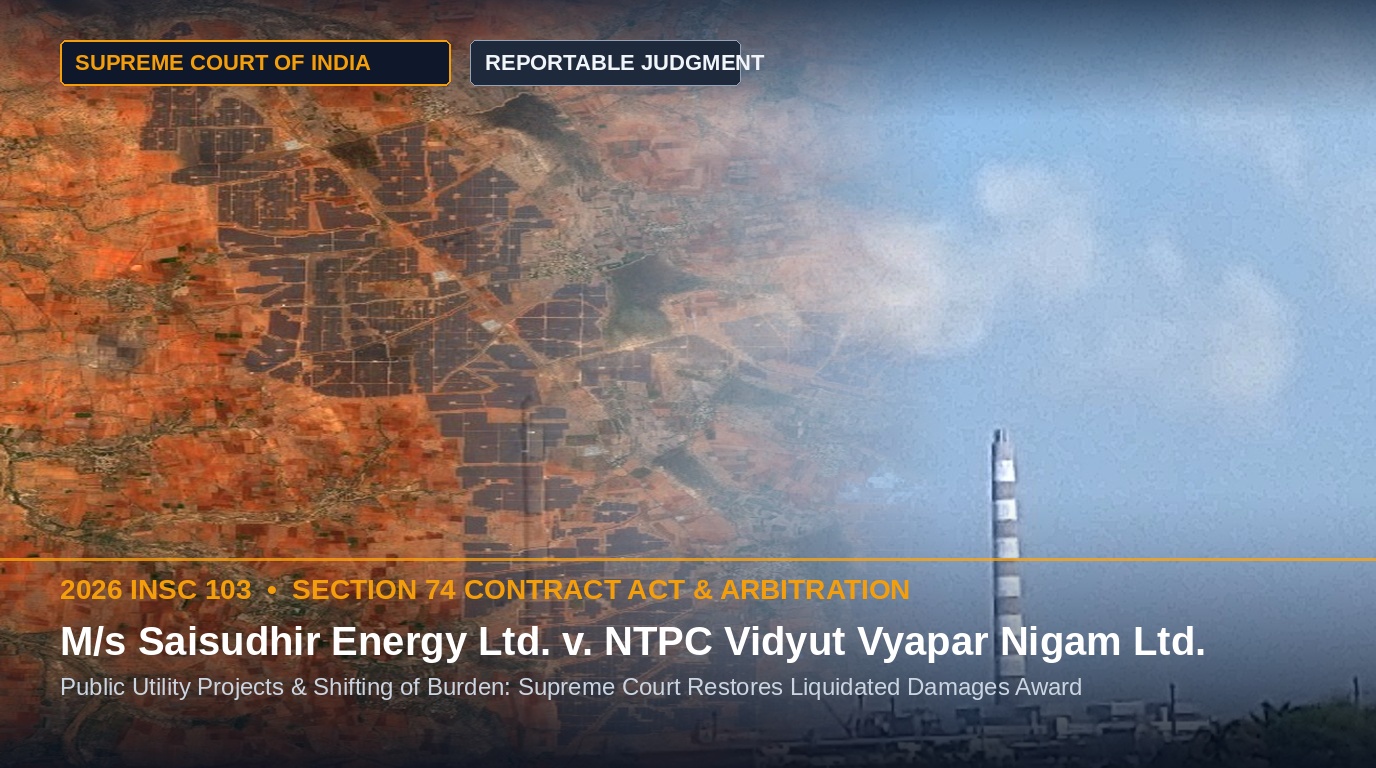
M/s Saisudhir Energy Ltd. v. M/s NTPC Vidyut Vyapar Nigam Ltd.
Bench: Hon'ble Mr. Justice Pamidighantam Sri Narasimha and Hon'ble Mr. Justice Atul S. Chandurkar (Authored by Chandurkar, J.)
Judgment Date: January 30, 2026 • Author of Analysis: yasin paravin u koppal
In M/s Saisudhir Energy Ltd. v. M/s NTPC Vidyut Vyapar Nigam Ltd. (2026 INSC 103), the Supreme Court of India delivered an authoritative pronouncement reconciling the law of liquidated damages under Section 74 of the Indian Contract Act, 1872 with the supervisory boundaries of the Arbitration and Conciliation Act, 1996. Deciding cross-appeals arising out of a delayed 20 MW solar power plant under the Jawaharlal Nehru National Solar Mission (JNNSM), a Division Bench comprising Justice Pamidighantam Sri Narasimha and Justice Atul S. Chandurkar held that in public utility and state infrastructure contracts, commercial delay inherently causes public injury. Applying the doctrine established in Construction and Design Services v. DDA, the Court ruled that the employer is not obliged to prove actual financial loss; instead, the legal burden shifts to the defaulting developer to establish that no loss was occasioned. Furthermore, the Apex Court reinforced the recent Constitution Bench ruling in Gayatri Balasamy by affirming the Section 34 court's limited power to modify an arbitral award to apply contract clauses to undisputed facts, while firmly holding under A.C. Chokshi that an appellate court under Section 37 cannot substitute its own computation for a plausible view taken by the Section 34 court.
| Case Reference & Judicial Metadata | |
|---|---|
| Case Title | M/s Saisudhir Energy Ltd. v. M/s NTPC Vidyut Vyapar Nigam Ltd. (Civil Appeal Nos. 12892–12893 of 2024 with Civil Appeal Nos. 12894–12895 of 2024) |
| Neutral Citation | 2026 INSC 103 (SupremeToday: 2026 Supreme(SC) 113) |
| Judgment Date | January 30, 2026 (New Delhi) |
| Bench / Judges | Hon'ble Mr. Justice Pamidighantam Sri Narasimha and Hon'ble Mr. Justice Atul S. Chandurkar (Authored by Chandurkar, J.; unanimous) |
| Court Appealed From | Division Bench of the High Court of Delhi (Common Judgment dated 18.01.2018 in FAO (OS) Nos. 334 & 336 of 2016) |
| Substantive Statutes | Arbitration and Conciliation Act, 1996 (Sections 9, 17, 34, 37); Indian Contract Act, 1872 (Section 74) |
| Operative Result | NTPC Vidyut Vyapar Nigam Ltd.'s appeals allowed; Saisudhir Energy Ltd.'s appeals dismissed. Division Bench judgment set aside to the extent of quantum modification; Single Judge award of 50% liquidated damages (~Rs. 27.06 Cr) fully restored. |
Download Official Companion Case Brief (PDF)
Complete analytical document with statutory tables, bench quotes, and procedural flowcharts.
1. Factual Matrix & The National Solar Mission Context
In 2010, the Government of India launched the ambitious Jawaharlal Nehru National Solar Mission (JNNSM) under the Ministry of Power, setting an aggressive national target of 20,000 MW of grid-connected solar power by 2022 to spearhead the transition to green energy. To implement Phase I, NTPC Vidyut Vyapar Nigam Ltd. (NVVNL) was designated as the central nodal agency. NVVNL was tasked with executing long-term 25-year Power Purchase Agreements (PPAs) with private solar power developers at preferential fixed tariffs and bundling this renewable energy with conventional thermal power for onward sale to state distribution utilities at regulator-determined rates.
On January 24, 2012, NVVNL entered into a 25-year PPA with M/s Saisudhir Energy Ltd. (SEL). Under the agreement, SEL undertook to construct, commission, and operate a 20 MW solar photovoltaic power generation facility. In exchange, NVVNL contracted to purchase the entire generated capacity at a tariff of Rs. 8.22 per unit, representing a substantial commercial discount against the Central Electricity Regulatory Commission (CERC) benchmark tariff of Rs. 15.39 per unit.
The agreed Scheduled Commissioning Date (SCD) for the plant was February 26, 2013 (thirteen months from contract execution). To guarantee strict adherence to timeframes essential for national grid scheduling, Clause 4.6 of the PPA established a rigorous, structured liquidated damages regime:
- First 3 Months of Delay (Clause 4.6.1): NVVNL was entitled to encash the developer's Performance Bank Guarantee (PBG) in graduated tranches (20% for 1 month delay, 40% for 2 months, 40% balance for 3 months).
- Delay Beyond 3 Months (Clause 4.6.2): Liquidated damages accrued at the liquidated contractual rate of Rs. 1,00,000 per MW per day for the delayed capacity, recoverable through bank guarantees or adjustments from power purchase receivables.
| Key Date | Chronological Event & Milestone |
|---|---|
| 24.01.2012 | PPA executed between SEL and NVVNL for a 20 MW solar power facility at Rs. 8.22/unit. |
| 30.01.2013 | SEL requests a two-month extension and issues a force majeure notice citing land and grid constraints. |
| 31.01.2013 | NVVNL rejects force majeure invocation due to non-compliance with the mandatory 7-day prior notice stipulation under Clause 11.5.1. |
| 26.02.2013 | Scheduled Commissioning Date (SCD) expires without plant commissioning. |
| 26.04.2013 | SEL synchronizes and commissions the first 10 MW capacity (two months after SCD). |
| 24.07.2013 | SEL synchronizes and commissions the balance 10 MW capacity (five months after SCD). Interim injunction obtained under Section 9 against bank guarantee encashment. |
| 21.07.2015 | Three-member Arbitral Tribunal delivers a split award (2:1). |
| 08.09.2016 | Single Judge of Delhi High Court (Section 34) sets aside majority award and awards 50% damages (~Rs. 27.06 Cr). |
| 18.01.2018 | Division Bench of Delhi High Court (Section 37) re-calculates compensation to Rs. 20.70 Cr plus BG charges. |
| 30.01.2026 | Supreme Court sets aside Division Bench modification and restores the Single Judge's Section 34 judgment. |
2. Procedural History & Split Opinions
The prolonged litigation travelled through three tiers of judicial evaluation before reaching the Supreme Court:
A. The Split Arbitral Award (21 July 2015)
Before the Arbitral Tribunal, NVVNL claimed encashment of bank guarantees and liquidated damages aggregating to Rs. 54,12,32,000 (Rs. 54.12 crore) computed strictly under Clause 4.6.2. SEL sought an extension of time, declaration that the liquidated damages clause was a penalty, and reimbursement of expenses.
- The Majority Arbitrators (2 members): Held that NVVNL had failed to lead any evidence demonstrating actual loss or financial damage suffered on account of the delayed commissioning. Relying on traditional principles of Section 74, the majority restricted NVVNL's recovery to Rs. 1.20 crore (being 20% of the initial performance bank guarantee at Rs. 30 lakh per MW) and rejected SEL's monetary claims.
- The Minority Arbitrator: Penned a vigorous dissent holding that in large-scale solar projects serving national clean energy targets, the exact quantification of loss is inherently difficult. Finding Clause 4.6 to be a genuine pre-estimate of loss, the minority held that NVVNL was fully entitled to encash bank guarantees amounting to Rs. 49.92 crore.
B. Single Judge under Section 34 (08 September 2016)
The Single Judge of the Delhi High Court, adjudicating petitions under Section 34 of the Arbitration Act, set aside the majority award. The Single Judge observed that breach by SEL was an admitted fact on record. However, recognizing that NVVNL had made no capital investment in the plant, suffered no direct expenditure, and that the plant was contracted to operate for 25 years against a brief delay of a few months, the Single Judge determined that awarding the full Rs. 54.12 crore would be disproportionate. Exercising equitable jurisdiction, the Single Judge awarded 50 percent of the contractual sum (amounting to approx. Rs. 27,06,16,000), directed to be recovered by NVVNL through monthly deductions of Rs. 25 lakh from future power purchase payments payable to SEL commencing October 1, 2016.
C. Division Bench under Section 37 (18 January 2018)
Both parties appealed to the Division Bench under Section 37. The Division Bench agreed that the majority arbitral award was contrary to public policy and that solar power PPAs serve a wider social object where proving exact damage is impossible. However, the Division Bench embarked upon an independent recalculation of the quantum. Reading Clause 4.6 as prescribing a stepped rate of Rs. 1,00,000 per MW for the delay period, the Division Bench reduced the compensation to Rs. 20.70 crore and added a direction requiring SEL to bear bank guarantee renewal charges.
3. Substantive Questions Framed by the Supreme Court
The Supreme Court analyzed the statutory interface between contract enforcement and arbitral finality through four central legal questions:
- Scope of Section 34 Modification: Whether the Section 34 court possessed the jurisdiction to modify the arbitral award to enhance compensation in the absence of an express statutory power of modification.
- Public Utility Exemption under Section 74: Whether a solar PPA under the JNNSM qualifies as a "public utility project," thereby dispensing with the strict requirement of proving actual damage or loss under Section 74 of the Contract Act.
- Reversal of the Evidentiary Burden: In public utility contracts where delay occurs, on whom does the burden of proof lie, and did SEL discharge its evidentiary burden?
- Supervisory Restraint under Section 37: Whether the Division Bench acting as an appellate court under Section 37 could re-work and reduce the quantum determined by the Section 34 court when that determination was plausible and not perverse.
4. Rival Arguments of the Parties
| Saisudhir Energy Ltd. (SEL) | NTPC Vidyut Vyapar Nigam Ltd. (NVVNL) |
|---|---|
|
1. Strict Proof of Loss Mandatory: NVVNL admitted it suffered no actual financial loss. Under Section 74 as interpreted in Kailash Nath Associates v. DDA, proof of damage or loss is an indispensable condition precedent for recovering compensation. 2. Purely Commercial Transaction: A bilateral PPA between a generator and a power trader is a commercial sale-and-purchase agreement. The mere umbrella of JNNSM does not convert it into a sovereign or public utility enterprise. 3. Distinction from Construction and Design Services: In Construction and Design Services, the public authority had funded the project and the contractor had abandoned the works. Here, SEL invested 100% of the capital, completed the plant, and has been generating green power for 25 years. 4. Impermissible Merits Review: Both the Single Judge and Division Bench exceeded their jurisdictional remit by rewriting the award and recalculating damages, violating Gayatri Balasamy and Associate Builders. |
1. Public Utility Doctrine Applies: The JNNSM is a critical national project for climate mitigation and energy security. Delays in solar commissioning directly deprive the public of green energy, and delay itself constitutes actionable loss under Construction and Design Services v. DDA. 2. Full Entitlement under Clause 4.6: NVVNL was contractually entitled to the full Rs. 54.12 crore. The Division Bench erred in substituting notions of equity and reducing the claim to Rs. 20.70 crore in violation of Chamundeshwari Electricity Supply Company. 3. Admission of Breach: The delay of two months (10 MW) and five months (balance 10 MW) was an admitted fact on record, rendering Clause 4.6.2 operational as a matter of law. 4. Avoidance of De Novo Litigation: The dispute originated in 2013; remanding parties to fresh arbitration after thirteen years would subvert the statutory objective of speedy dispute resolution. |
5. Ratio Decidendi & Core Legal Principles
The judgment authored by Justice Atul S. Chandurkar for the unanimous Bench establishes three foundational principles of commercial arbitration and contract law:
1. Public Utility Contracts & The Presumption of Loss (Section 74)
The Supreme Court decisively rejected SEL's contention that Section 74 invariably mandates mathematical proof of actual financial damage. The Court held that where a contract serves a public utility purpose and advances national public interest:
"Where the contract serves a public utility purpose and public interest, the delay itself can be taken to cause loss... The burden is then on the party in breach to show that no loss was caused or that the stipulated sum is a penalty. If that burden is not discharged, the employer is entitled to reasonable compensation under Section 74 up to the contractual sum, without proving actual loss." (Para 16)
The Court held that the JNNSM framework, executed through NVVNL as a government nodal agency to achieve national renewable targets, is indisputably a public utility endeavor. Timelines in such projects are sacrosanct. Because SEL failed to lead evidence establishing that no public injury occurred or that Clause 4.6 represented an extortionate in terrorem penalty, NVVNL was entitled to liquidated damages.
2. Permissible Scope of Modification under Section 34
Addressing whether the Section 34 court could legally enhance the arbitral award from Rs. 1.20 crore to approx. Rs. 27.06 crore, the Supreme Court relied upon the landmark Constitution Bench ruling in Gayatri Balasamy v. ISG Novasoft Technologies Ltd. (2025 INSC 605). The Court clarified that while a Section 34 court cannot sit as a court of appeal or reassess evidentiary findings on merits, it possesses the limited power to modify an award by:
- Correcting manifest errors of law apparent on the face of the award;
- Applying an express contractual formula to admitted, undisputed facts; and
- Severing unreasoned or perverse portions while giving effect to the governing terms agreed by the parties.
Since SEL's breach and the period of delay were undisputed, the Single Judge's application of Clause 4.6 was a legitimate exercise within the narrow confines of Section 34.
3. Supervisory Restraint under Section 37
Reiterating the strict supervisory charter of Section 37 established in A.C. Chokshi Share Broker Pvt. Ltd. v. Jatin Pratap Desai (2025 INSC 174), the Supreme Court ruled that an appellate bench under Section 37 is not an appellate court over the Section 34 judge:
- The Section 37 court must exclusively verify whether the Section 34 court exercised its jurisdiction properly.
- It cannot re-weigh equities, re-calculate compensation, or substitute its own subjective figure for a plausible determination made under Section 34.
- Unless the Section 34 court's award is demonstrated to be arbitrary, perverse, or exceeding jurisdiction, the Section 37 bench has no authority to interfere.
6. Operative Decision & Restored Monetary Relief
Applying these doctrines, the Supreme Court pronounced the following operative orders:
- Reversal of Division Bench Modification: The judgment of the Division Bench of the Delhi High Court dated January 18, 2018 is set aside to the extent it reduced the compensation to Rs. 20.70 crore.
- Restoration of Single Judge Judgment: The judgment of the Single Judge in OMP Nos. 410 of 2015 and 446 of 2015 dated September 8, 2016 is fully restored.
- Recovery Mechanism: NVVNL is confirmed entitled to 50 percent of the contractual liquidated damages (approx. Rs. 27,06,16,000), recoverable through monthly adjustments of Rs. 25,00,000 from power purchase disbursements payable to SEL.
- Disposal of Appeals: Civil Appeal Nos. 12894–12895 of 2024 (NVVNL) are allowed; Civil Appeal Nos. 12892–12893 of 2024 (SEL) are dismissed. Parties were directed to bear their own costs.
7. Critical Legal Commentary & Practical Industry Impact
| Dimension | Analysis & Strategic Implications |
|---|---|
| Renewable Energy Developers | Contractors under national renewable programs (SECI, NTPC, State Discoms) can no longer insulate themselves from liquidated damages by asserting that the off-taker made no direct capital investment. The evidentiary burden now firmly rests upon the developer to prove that delay caused zero public detriment. |
| Public Nodal Agencies | Government instrumentalities and off-takers obtain reinforced legal armor to encash bank guarantees and deduct pre-estimated delay damages without maintaining burdensome accounting trails of lost tariff differentials. |
| Section 37 Practice | Appellate benches in High Courts are sent an unmistakable signal: Section 37 appeals cannot be treated as second-tier commercial arbitrations to re-compute quantum or split differences. |
| Academic Debates | As noted in Bar and Bench commentary, the decision entrenches the broad 'public utility' presumption originating in Construction and Design Services. Future benches will likely need to refine what specific contractual hallmarks differentiate a true sovereign utility project from an ordinary commercial government purchase. |
Case Analysis By: yasin paravin u koppal
Legal Researcher & Case Law Analyst at LLM Advocates. Specializes in commercial arbitration, infrastructure contracts, energy law, and Supreme Court appellate practice.

