PHP2Shell: Two Critical PHP Flaws, Why They Caused Panic, and What Indian Law Expects From You
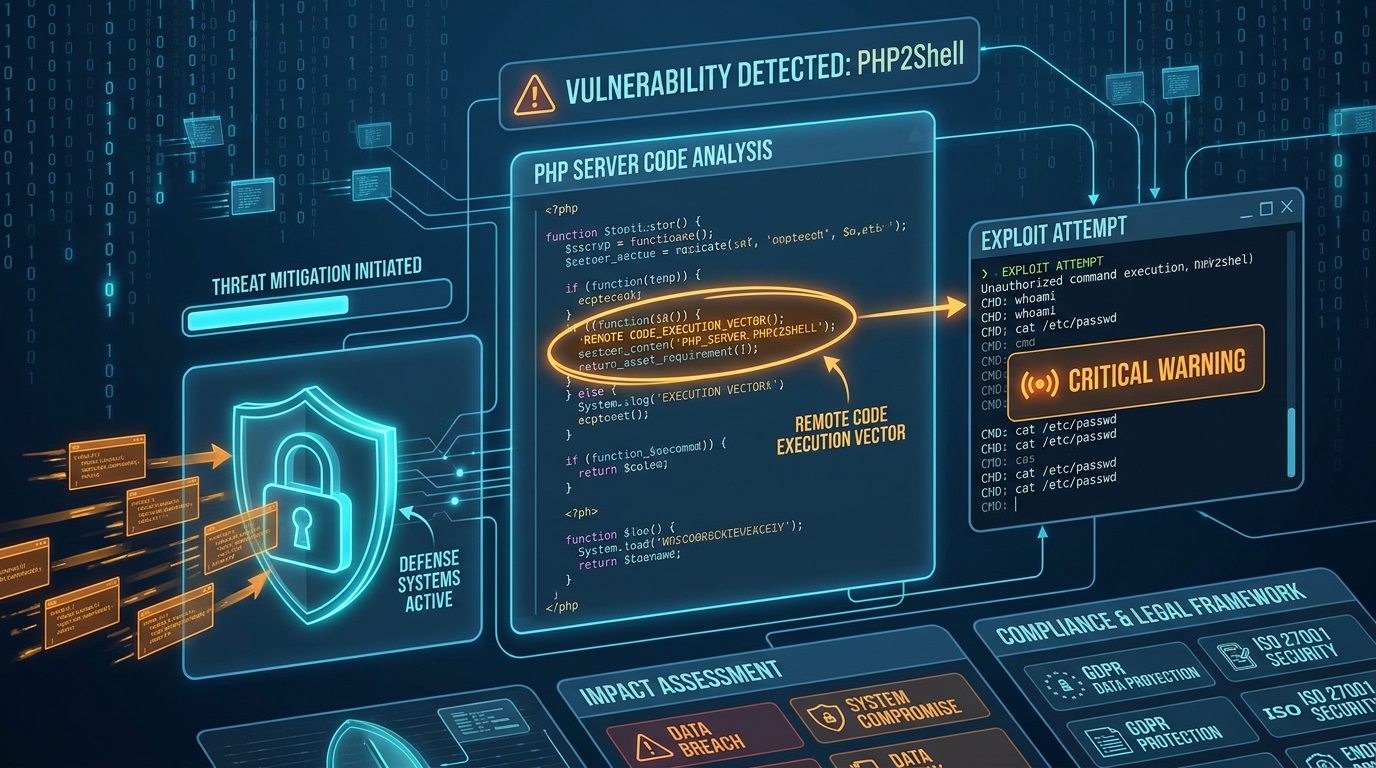
PHP quietly powers the backbone of the global internet, from mission-critical enterprise systems and e-commerce platforms to higher-education portals and government databases. When two severe security vulnerabilities in the PHP core were disclosed this week, system administrators, security teams, and legal counsel worldwide scrambled into emergency response mode.
What Happened: The Anatomy of PHP2Shell
On October 20, the PHP security team issued an urgent pre-disclosure warning urging systems engineers to prepare for emergency out-of-cycle patching, following an unauthorized technical leak of zero-day vulnerabilities ahead of the coordinated disclosure schedule. The official security patches shipped on October 21, 2026 at 14:00 UTC.
The incident involves two critical vulnerabilities tracked as CVE-2026-109618 and CVE-2026-109619, each assigned a severe Common Vulnerability Scoring System (CVSS v4.0) base score of 9.2. Collectively dubbed PHP2Shell by the global threat intelligence community, these flaws reside in the core PHP runtime architecture rather than in isolated third-party extensions, libraries, or CMS plugins.
Technically, the vulnerabilities involve:
- Improper Handling of Out-of-Memory Conditions: A failure state leading to remote memory corruption and unconstrained remote code execution (RCE).
- Stale Internal State and Use-After-Free (CWE-416): Memory allocation flaws that allow arbitrary heap exploitation and code injection within active server threads.
While classifications vary slightly across international cyber agencies—such as the Canadian Centre for Cyber Security classifying both issues under use-after-free conditions—the authoritative technical baseline remains the official upstream PHP advisory.
Why PHP2Shell Created Severe Industry Disruption
Several compounding factors escalated PHP2Shell from a routine patch release into an urgent enterprise crisis:
- Pre-Patch Technical Leak: Security researchers at watchTowr confirmed laboratory reproduction of CVE-2026-109618 prior to public patch deployment. When exploit viability is verified before defenders can patch, the attack window collapses dramatically.
- Massive Global Attack Surface: The vulnerability affects virtually all environments serving PHP requests, including PHP-FPM, Apache mod_php, php-cgi, FrankenPHP, and LiteSpeed web servers.
- Shadow PHP and Embedded Dependencies: As highlighted in an urgent advisory by Singapore’s Cyber Security Agency (CSA), PHP is frequently embedded deep within enterprise networking appliances, container base images, legacy internal panels, and storage consoles, often overlooked by IT asset inventories.
- Stranded End-of-Life Versions: Systems operating on PHP 8.1, PHP 7.x, or legacy PHP 5 no longer receive official upstream security updates. Organizations on unsupported branches face catastrophic exposure with no native vendor patch available.
- Accelerating Threat Chatter: Unverified proof-of-concept (PoC) exploit scripts and targeted scanner signatures began circulating rapidly across threat intelligence forums and social networks. In such high-velocity threat landscapes, passive defense is untenable.
Actionable Remediation and Threat Hunting Protocol
Enterprise defense teams must execute a structured technical remediation pipeline immediately:
- Comprehensive Infrastructure Audit: Identify every active PHP binary across bare-metal servers, virtual machines, Docker container registries, CI/CD runners, and managed vendor appliances.
- Apply Official Patched Releases: Upgrade immediately to fixed versions: PHP 8.5.12, PHP 8.4.27, PHP 8.3.36, or PHP 8.2.35. Systems running older branches must be isolated or migrated immediately.
- Mandatory Worker Restart: Package installation alone does not replace running memory processes. System administrators must restart active process managers (for example, restarting PHP-FPM workers or executing a graceful reload of the Apache daemon) to cycle out vulnerable memory instances.
- Functional and Security Regression Testing: Validate core application workflows, database connection pools, file upload handlers, and authentication modules post-upgrade.
- Compensating Perimeter Controls: Where instantaneous patching is blocked by operational dependencies, isolate internet-facing PHP endpoints behind Zero Trust Network Access (ZTNA), strict web application firewall (WAF) rule sets, or temporary network isolation.
- Proactive Threat Hunting: Inspect server access logs, web directories, and upload paths for indicators of compromise (IoC). Search for unauthorized PHP scripts, unexpected background cron entries, rogue administrative accounts, or anomalous outbound reverse shell network traffic.
- Supply-Chain Vendor Verification: Issue formal inquiries to third-party SaaS vendors, CMS maintainers, and managed hosting providers to verify patch verification status.
The Indian Legal Landscape: Statutory Liabilities and Compliance Mandates
For organizations operating in India or handling Indian citizens’ data, the compromise of an unpatched PHP server is not merely an IT outage—it triggers stringent, overlapping statutory obligations and legal liabilities across Indian cyber jurisprudence.
1. Information Technology Act, 2000 and CERT-In Mandatory 6-Hour Reporting
Under the CERT-In Cyber Security Directions issued in April 2022 (mandated under Section 70B of the Information Technology Act, 2000), all service providers, intermediaries, data centers, body corporates, and government agencies are legally obligated to report specified cyber incidents to the Indian Computer Emergency Response Team (CERT-In) within six hours of detection.
Incidents qualifying under this mandate include:
- Unauthorized access to IT systems and networks.
- Remote code execution and system intrusion.
- Attacks on servers such as database compromises and web defacement.
- Data breaches involving unauthorized leaks or exfiltration.
Failure to report within this statutory six-hour window can invite regulatory enforcement and penalties under Section 70B(7) of the IT Act, which includes fines up to ?1,00,000 and potential imprisonment for non-compliance.
2. Section 43A and SPDI Rules: Civil Compensation for Security Negligence
Section 43A of the Information Technology Act, read in conjunction with the Information Technology (Reasonable Security Practices and Procedures and Sensitive Personal Data or Information) Rules, 2011 (SPDI Rules), holds body corporates strictly liable to pay compensation to affected persons if failure to maintain "reasonable security practices" leads to wrongful loss or wrongful gain.
In Indian courts, failing to patch a widely publicized, CVSS 9.2 critical remote code execution vulnerability within a reasonable timeframe is strong evidence of statutory negligence. If sensitive personal data is compromised through PHP2Shell, defending the organization’s security posture under Section 43A becomes legally tenuous.
3. Digital Personal Data Protection (DPDP) Act, 2023: The 72-Hour Breach Protocol
The Digital Personal Data Protection (DPDP) Act, 2023 broadens enterprise liability significantly. A personal data breach is defined expansively as any unauthorized processing, access, destruction, loss, alteration, or disclosure that compromises the confidentiality, integrity, or availability of personal data.
Under the DPDP framework:
- Two-Stage Intimation Protocol: Data Fiduciaries must notify the Data Protection Board of India (DPBI) and affected Data Principals (users) immediately upon discovering a breach, followed by a detailed forensic and impact assessment within 72 hours.
- Severe Financial Penalties: Failure to implement reasonable security safeguards to prevent a personal data breach attracts financial penalties of up to ?250 crore under Schedule 1 of the DPDP Act. Failure to inform the Board or affected Data Principals carries penalties up to ?200 crore.
4. The Dual-Clock Challenge: Synchronizing CERT-In and DPDP Obligations
The DPDP Act does not supersede or extinguish CERT-In directions; both statutory clocks run concurrently. During an active incident:
- Clock 1: You must provide a formal notification to CERT-In within 6 hours.
- Clock 2: You must initiate notification to the Data Protection Board and impacted individuals, followed by the comprehensive 72-hour DPDP filing.
Legal teams and technical incident responders must maintain pre-approved incident disclosure templates and communication channels to avoid procedural defaults under either law.
5. Legal Warning on Exploit Testing and Scanning
With proof-of-concept exploits circulating publicly, security researchers and internal teams must exercise extreme caution. Conducting unauthorized vulnerability scans, automated fuzzing, or exploit execution against external servers without explicit written authorization constitutes unauthorized access under Section 43 and Section 66 of the Information Technology Act, carrying potential criminal liability. Security testing must be strictly confined to owned or authorized assets.
Strategic Incident Checklist for Indian CISOs and Enterprises
- Immediate Patch Verification: Deploy patched PHP packages (8.5.12, 8.4.27, 8.3.36, 8.2.35) and verify worker restarts within hours, prioritizing perimeter systems.
- Forensic Log Preservation: Ensure access logs, error logs, and system audit trails are archived securely to satisfy statutory evidentiary standards under Section 63 of the Bharatiya Sakshya Adhiniyam (BSA), 2023.
- Designated CERT-In Compliance Officer: Appoint and empower a single point of contact responsible for drafting and dispatching timely incident notifications.
- Pre-Drafted Breach Communications: Prepare standardized disclosure templates for both CERT-In and the Data Protection Board to eliminate delays during the critical six-hour window.
- Documentation of Remediation: Maintain strict timestamped records of when patches were applied. In the event of regulatory scrutiny, these records demonstrate reasonable security diligence.
- Decommission EOL Environments: Immediately retire, sandbox, or migrate systems operating on unsupported PHP 8.1 or older releases.
Conclusion: Bridging the Gap Between Code and Compliance
The PHP2Shell vulnerability underscores a fundamental reality of contemporary cybersecurity: vulnerability management is no longer merely a technical maintenance task—it is a critical statutory and governance responsibility.
In the Indian regulatory framework, an unpatched server leading to unauthorized access triggers strict six-hour and seventy-two-hour statutory timers, coupled with unprecedented financial exposure. Organizations must treat patching as an immediate legal priority, ensuring robust technical remediation is matched by disciplined forensic documentation and compliance readiness.