Google Search Gets Its Biggest AI Upgrade Yet: Inside the Global Rollout of Gemini 4 Hydrogen
Published 13 November 2026 · LLM Advocates — AI Governance & Technology Law Practice
Key Takeaways
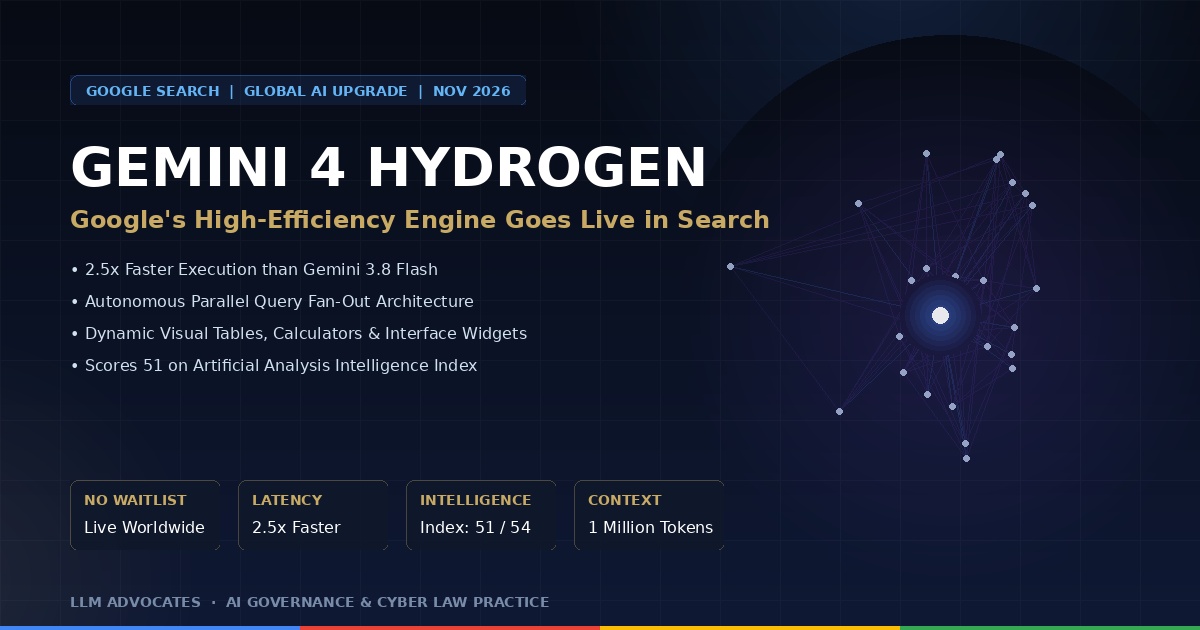
- Global Deployment: Gemini 4 Hydrogen is live worldwide across Google Search (AI Overviews & AI Mode) with no waitlist.
- Parallel Query Fan-Out: Complex questions are decomposed into multiple sub-queries executed simultaneously, uncovering deeper and more diverse web sources.
- 2.5x Faster Throughput: Hydrogen executes tasks 2.5 times faster than its predecessor, Gemini 3.8 Flash.
- Benchmark Milestone: Scored 51 on the Artificial Analysis Intelligence Index at High thinking, outperforming Gemini 4 Argon (50) and reaching 54 on Xhigh.
- Developer Pricing: Available via Gemini API and Google AI Studio at $1.50 per 1M input tokens and $7.50 per 1M output tokens across a 1M token context window.
Google has officially turned on its newly unveiled Gemini 4 Hydrogen model across Search worldwide. Built as the ultra-fast, high-efficiency engine of the next-generation Gemini 4 family, Hydrogen powers both standard AI Overviews and interactive AI Mode with zero waitlists. Google describes the release as its most consequential architectural overhaul of Search to date.
For more than two decades, the global web has revolved around keyword indexing and PageRank. With Gemini 4 Hydrogen, Google is completing its transition from an information index into an interactive, parallel reasoning engine. Here is a technical and strategic breakdown of what changed, how the benchmarks stack up, and what it means for consumers, software developers, and web publishers.
1. Conversational Querying Replaces "Searchese"
For years, search engine optimization forced internet users into a restrictive syntactic habit: stripping natural, nuanced questions into robotic keyword strings like "best corporate law firm contract review delhi cost turnaround".
With Gemini 4 Hydrogen, Search moves to true conversational intent comprehension. Users can submit lengthy, multi-layered queries loaded with real-world context, contradictory constraints, or colloquial phrasing, and the model isolates each substantive premise without requiring keyword refinement.
Example Real-World Multi-Part Query:
"I'm opening a cross-border fintech subsidiary in GIFT City Gujarat and need to structure our client data flows. Compare RBI cross-border payment compliance vs DPDP Act Section 16 data transfer rules, include timeline requirements for audit logs, and give me a checklist table of required corporate filings."
Instead of matching strings against indexed web documents, Hydrogen evaluates the regulatory categories, jurisdiction, and format requirements simultaneously.
2. Parallel "Query Fan-Out": Searching the Web in Multiple Dimensions
When faced with a complex prompt, earlier search architectures typically fired a single aggregated query against an index. This often resulted in homogenized answers dominated by major aggregator websites.
Hydrogen incorporates autonomous query decomposition, commonly referred to as parallel query fan-out:
- Subtopic Splitting: The model dynamically decomposes a complicated question into 3 to 8 independent sub-queries.
- Parallel Execution: Each sub-query executes concurrently across specialized indexes, statutory databases, academic archives, and technical documentation.
- Synthesized Web Citation: The model synthesizes the parallel streams into an integrated response while citing source URLs from a significantly broader cross-section of primary sources.
According to Google's engineering team, this parallel architecture surfaces niche statutory portals, independent expert blogs, and specialized industry documentation that traditional keyword queries routinely overlooked.
3. Beyond Text: Dynamic On-the-Fly Interface Elements
Search results generated by Hydrogen are no longer restricted to static text paragraphs accompanied by traditional hyperlinks. Leveraging native multi-modal rendering, the system dynamically constructs tailored UI modules directly inside the results page:
- Automated Comparison Matrices: Comparing competing legal standards, cloud architectures, or hardware specifications triggers structured, side-by-side spec tables with expandable parameter notes.
- Interactive Tools & Calculators: Queries involving statutory interest rates, tax slabs, or loan amortisation automatically spawn functional client-side interactive sliders and calculators.
- Structured Visual Breakdowns: Technical workflows and multi-step statutory procedures are presented with structured diagrams and contextual imagery paired alongside legal citations.
4. Benchmark Performance: The "51 to 50" Milestone
Early iterations of generative search faced persistent user friction around latency and inference cost. Gemini 4 Hydrogen was engineered specifically as an execution engine that balances speed with analytical rigor.
| Metric / Benchmark | Gemini 4 Hydrogen | Comparison / Context |
|---|---|---|
| Execution Speed | 2.5x faster throughput | Compared to predecessor Gemini 3.8 Flash |
| Artificial Analysis Index (High) | Score: 51 | Outperforms Gemini 4 Argon (Score: 50) at same thinking level |
| Artificial Analysis Index (Xhigh) | Score: 54 | Pushed to maximum reasoning configuration |
| Context Window | 1,000,000 tokens (1M) | Full million-token multi-modal context capability |
| Reasoning Tiers | Low, Medium, High, Xhigh | Configurable effort levels to balance latency vs depth |
The score of 51 on the Artificial Analysis Intelligence Index is particularly noteworthy: it demonstrates that a high-throughput, low-latency model can deliver reasoning quality rivaling heavier, compute-intensive frontier models when paired with optimized architectural pipelines.
5. Developer Availability & Token Economics
In parallel with consumer Search, Google released Gemini 4 Hydrogen across Google AI Studio and the Gemini API for production software deployments:
- Input Tokens: $1.50 per 1 million input tokens.
- Output Tokens: $7.50 per 1 million output tokens (flat rate across the entire 1M token window).
- Agentic Workflows: Built for autonomous sub-tasking, code repository debugging in IDEs (like Cursor), and high-frequency tool use.
By pricing Hydrogen competitively while maintaining a 1M context window and near-instant time-to-first-token (TTFT), Google has positioned the model as an everyday workhorse for high-volume enterprise pipelines.
The Legal & Governance Angle: AI Search in the Regulatory Crosshairs
As AI becomes the default presentation layer of the internet, the implications for technology law, intellectual property, and competition policy are accelerating:
- Copyright & Fair Use: When an AI model answers multi-part queries by synthesizing multiple websites into interactive widgets, content publishers face heightened traffic diversion risks. How jurisdictions evaluate fair use and intermediary liability under the IT Act and global digital copyright frameworks will define publisher relations over the coming year.
- Algorithmic Provenance & Attribution: With parallel query fan-out pulling from dozens of subtopics, clear and verifiable citation mechanisms are critical to prevent source hallucination and ensure evidentiary accountability under frameworks like the DPDP Act and AI governance guidelines.
- Enterprise Information Security: As employees interact with conversational search engines using sensitive enterprise queries, corporate data loss prevention (DLP) policies must account for prompt-level data ingestion by external frontier models.
Conclusion: The Web Becomes an Executable Knowledge Base
The global activation of Gemini 4 Hydrogen marks the closing chapter of search as an index lookup utility. By integrating parallel reasoning, near-instant sub-second throughput, and dynamically rendered interface tools, Google Search has evolved into an interactive answer engine.
For regular searchers, asking questions feels as natural as human conversation. For organizations, understanding how AI models discover, cite, and evaluate corporate data assets is now an essential element of modern digital governance.
About LLM Advocates: LLM Advocates is a premier cyber law and technology jurisprudence practice advising enterprise clients on Artificial Intelligence Law & Governance, Cyber Law Compliance, and IP Protection. For strategic advisory or regulatory evaluation, connect with our legal team.
Sources: Official Google Launch Announcement (November 12, 2026); Artificial Analysis Intelligence Index benchmarks; Google AI Studio documentation; DeepMind Research publications.

